
ACCURRA-TCD measures hydrogen purity by platinum thermal conductivity with no reference gas, over 0 to 100 % depending on the background gas: air, nitrogen, argon, helium, oxygen, CO or methane. It assumes a binary mixture, so a varying third gas shifts the reading.
The measurement and why it matters
A thermal conductivity detector heats a sensing element and measures how fast the surrounding gas carries heat away. Hydrogen's thermal conductivity is roughly seven times that of nitrogen, so even a small change in hydrogen concentration gives a large signal. That is why TCD is the standard method for hydrogen purity and for hydrogen in a known background.
ACCURRA-TCD is Sarvesh's thermal conductivity analyser, a product line of its own alongside ACCURRA-S. For hydrogen it measures over 0 to 100 percent, with the usable range depending on the background gas, and works with one of air, nitrogen, argon, helium, oxygen, carbon monoxide or methane as the background. Display resolution is 0.01 percent and repeatability is better than 1 percent of full scale.
A thermal conductivity reading assumes two components. If a third gas varies in the sample, the reading shifts, so tell us the full composition and we will review the method. Sample flow should be about 1 LPM, and the catalogue lists an operating temperature of 5 to 45 C.
Models and ranges
| Model | Measures | Range | Sensor and notes |
|---|---|---|---|
| ACCURRA-TCD | Hydrogen | 0 to 100 %, depends on background gas | Platinum thermal conductivity, no reference gas |
| ACCURRA-TCD | Hydrogen in binary mixtures | Binary mixtures | Repeatability below 1 % of FS, linearity below 1 % of range, errors and drift below 1 % of FS per week; T90 below 10 s at 0.6 LPM |
| Backgrounds | One of air, N2, Ar, He, O2, CO, CH4 | Background must be known and steady |
Process notes
Hydrogen purity
A thermal conductivity detector measures how well a gas carries heat away from a heated element. Hydrogen and helium conduct heat several times better than nitrogen, oxygen or argon, so the signal changes strongly with their concentration. That makes TCD a natural choice for hydrogen purity, for helium, and for argon-nitrogen mixes.
Many TCD analysers compare the sample against a reference gas, which means another cylinder, a regulator and a running cost. ACCURRA-TCD removes that reference requirement. The measurement assumes a binary mixture, so if the stream contains a third component, tell us and we will check how it affects the reading.
Sampling and installation
- Provide about 1 LPM of sample at a regulated pressure.
- Filter the sample upstream; a Headline filter protects the sensor from particulates and mist.
- This is a safe-area analyser. For hydrogen measurement in hazardous areas, see ACCURRA-Hz.
- The reading assumes a binary mixture. Tell us if a third gas varies.
Send us your process data
The same pre-order design inputs our engineers design from, online. Fill in what you know, leave the rest. Your draft saves as you go, and you can print or send it when ready.
What the data sheet asks for
Send what you have and we will ask for the rest.
- The gases to measure, the range, and the accuracy you need
- Background gases and their typical composition
- Sample temperature, pressure and dew point at the tapping point
- Dust level, and whether the gas carries tar, oil or condensable vapour
- Process connection and, for ducts, the duct diameter
- Where the sample vents to, and at what pressure
- Area classification of the tapping point and of the analyser location, and the IP protection needed
- Distance between the tapping point and the analyser
- Outputs you need: 4-20 mA, dual range, relays, Modbus RTU
- Calibration approach, calibration gas available, and whether blowback is required
- Utilities at site: power supply, instrument air, nitrogen, steam and cooling water, and the ambient temperature range
- The background gas and its range of variation, and the hydrogen range
Recommended Sarvesh products
ACCURRA-TCD
Binary thermal conductivity analyser.
View ACCURRA-TCD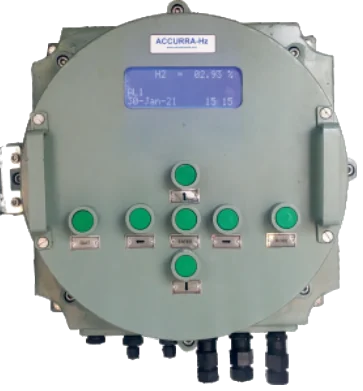
ACCURRA-Hz
Hazardous-area hydrogen measurement.
View ACCURRA-HzHeadline filters
Filters upstream of the sensor.
View Headline filtersFrequently asked questions
Does the hydrogen analyser need a reference gas?
No.
What background gases can it work with?
Air, nitrogen, argon, helium, oxygen, carbon monoxide or methane, any one at a time.
What if my sample has three components?
Tell us the composition. A third gas changes the thermal conductivity, and we will advise on the accuracy or an alternative method.
Can I use it in a hazardous area?
ACCURRA-S is a safe-area analyser. Use ACCURRA-Hz, certified for Gas Group IIC, Zone 1 and 2, T6.