
ACCURRA-Zr measures percent oxygen in flue gas in situ with a zirconia sensor, calibrates on plain air and cleans its probe with automatic blowback. Options cover high dust loads and process temperatures up to 1400 C.
The measurement and why it matters
A boiler burns fuel with air. Burning with exactly the theoretical amount gives incomplete combustion in practice, so plants run with some excess air, measured as percent oxygen in the flue gas. Each extra percent of oxygen carries heat out of the stack, while too little oxygen raises carbon monoxide and soot. The oxygen reading is the control variable for trimming air.
A zirconia cell is a ceramic element that develops a voltage proportional to the difference in oxygen between the flue gas and a reference, usually air. It works at high temperature; ACCURRA-Zr keeps it just outside the duct wall, fed through a guide tube, and reads oxygen almost without delay and with no sample line to condense or block.
ACCURRA-Zr is the in-situ answer for boilers, furnaces and stacks. Calibration is single-point with air. Built-in automatic blowback keeps the probe clear, and there are options for high dust load and for process temperature up to 1400 C. For extractive measurement of other flue components, see the stack monitoring page.
Models and ranges
| Model | Measures | Range | Sensor and notes |
|---|---|---|---|
| ACCURRA-Zr | Oxygen in flue gas | Percent | Zirconia sensor, in-situ probe |
| High-temperature option | Process temperature | Up to 1400 C | Probe option |
| High dust load option | Dust | High dust load probes | Optional |
Process notes
Boilers and HRSG
A boiler burns fuel with air. Burning with exactly the theoretical air gives incomplete combustion in practice, so plants run with some excess air, typically measured as percent oxygen in flue gas. Each extra percent of oxygen carries heat out of the stack, while too little oxygen raises CO and soot.
A zirconia cell measures oxygen directly in the hot flue gas using a heated ceramic element, with no sample line to condense or block. ACCURRA-Zr adds automatic blowback to keep the probe clear in dusty gas. In a heat recovery steam generator, oxygen after the duct burner shows how much air remains for the burner.
Sampling and installation
- In-situ measurement needs no sample line.
- Mount the probe where gas flows evenly, away from air leaks and stratified zones.
- Use the built-in blowback for dusty fuels, and the high dust option for heavy loading.
- For extractive measurement of other flue components see the stack monitoring page.
Send us your process data
The same pre-order design inputs our engineers design from, online. Fill in what you know, leave the rest. Your draft saves as you go, and you can print or send it when ready.
What the data sheet asks for
Send what you have and we will ask for the rest.
- The gases to measure, the range, and the accuracy you need
- Background gases and their typical composition
- Sample temperature, pressure and dew point at the tapping point
- Dust level, and whether the gas carries tar, oil or condensable vapour
- Process connection and, for ducts, the duct diameter
- Where the sample vents to, and at what pressure
- Area classification of the tapping point and of the analyser location, and the IP protection needed
- Distance between the tapping point and the analyser
- Outputs you need: 4-20 mA, dual range, relays, Modbus RTU
- Calibration approach, calibration gas available, and whether blowback is required
- Utilities at site: power supply, instrument air, nitrogen, steam and cooling water, and the ambient temperature range
- Fuel, duct temperature, dust loading and the available insertion length
Recommended Sarvesh products
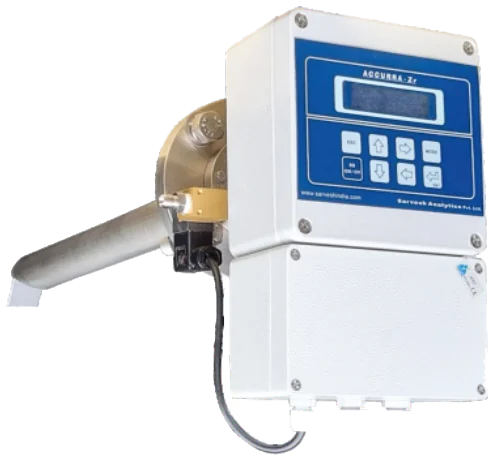
ACCURRA-Zr
In-situ zirconia oxygen analyser.
View ACCURRA-Zr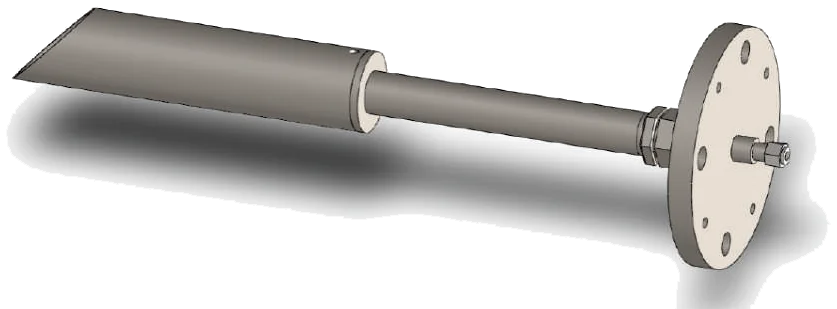
SP and SRP sample probes
High-temperature probes where extraction is needed.
View SP and SRP sample probesFrequently asked questions
How is ACCURRA-Zr calibrated?
With plain air at a single point, so no span cylinder is needed.
Can it work on very hot gas?
There is an option for temperatures up to 1400 C.
Does it handle dust?
It has built-in automatic blowback and an option for high dust load.
What oxygen setpoint should I use?
It depends on fuel and burner. Gas-fired boilers run with less excess air than coal. Your burner supplier's curve sets the target.
More in Power, boilers and emissions
- Stack and emission monitoring
- Thermal oxidiser and scrubber efficiency
- Cement kiln and precalciner O2 and CO
- Coal mill inerting and fire protection
- Waste-heat recovery boilers and kiln WHRS
- Biomass, bagasse and rice-husk boiler combustion trim
- Thermic-fluid heaters and hot-air generators
- Glass melting furnace combustion trim
- Boiler and burner factory test benches
- All power, boilers and emissions applications
- Browse analysers by gas