
ACCURRA-TCD measures one gas in another by thermal conductivity with a platinum sensor and no reference gas. It reads H2, He, Ar, N2, N2O, Ne and Kr in binary mixtures, with linearity within 1 % of range and errors and drift within 2 %.
Why ACCURRA-TCD
No reference gas to buy
No sealed reference and no continuous reference flow, so there is no second cylinder, regulator or running cost.
A stable, low-noise reading
Repeatability and linearity below 1 %, drift below 1 % of full scale per week, and T90 below 10 seconds at 0.6 LPM.
Two measurements in one unit
Add a trace oxygen or moisture sensor in series, for example O₂ ppm with N₂ % in argon, each with its own output and Modbus ID.
Specifications
| Item | Specification | Notes |
|---|---|---|
| Gases | H2, He, Ar, N2, N2O, Ne, Kr | Binary mixtures |
| Sensor | Platinum thermal conductivity; no sealed reference and no reference gas flow | |
| Response time | T90 below 10 s at 0.6 LPM | |
| Repeatability | Below 1 % of full scale | |
| Linearity | Below 1 % of range | |
| Errors and drift | Below 1 % of full scale per week | |
| Display resolution | 0.01 % | |
| Sample flow | 0.6 LPM recommended | Regulated externally; built-in flow indicator |
| Output | Isolated 4-20 mA, dual range, max load 500 ohm; Modbus RTU over RS 485 | 6 failsafe SPST relays: two alarms, fault, sample pump or range ID, two for auto-calibration valves |
| Models | 1030 hydrogen, 7130 helium, 7230 argon, 7330 nitrogen, 7530 nitrous oxide | Second component optional: 3015, 3030, 6015, 6030 or M015 |
| Sample temperature | 5 to 45 C | Dew point at least 5 C below the lowest ambient |
| Power | 100 to 240 V AC, 50/60 Hz, 45 W | |
| Enclosure | 19 inch rack or panel, IP 20, safe area | 134 H x 483 W x 180 or 280 D mm |
From the current Sarvesh product datasheets and company profile. Specifications may change without notice as products improve. The final responsibility to check that a product meets the process and analyser requirement remains with the customer.
Ranges by background gas
| Measured gas | Background gas | Ranges |
|---|---|---|
| Hydrogen | Nitrogen, air, CO2 or methane | 0 to 100 %, 0 to 3 % or 97 to 100 % |
| Hydrogen | Argon | 0 to 100 %, 0 to 3 % or 97 to 100 % |
| Hydrogen | Helium | 20 to 100 %, 20 to 40 % or 85 to 100 % |
| Hydrogen | Oxygen | 0 to 100 %, 0 to 4 % or 97 to 100 % |
| Helium | Nitrogen or air | 0 to 100 %, 0 to 3 % or 97 to 100 % |
| Helium | Argon | 0 to 100 %, 0 to 3 % or 97 to 100 % |
| Argon | Nitrogen, air or oxygen | 0 to 100 %, 0 to 5 % or 96 to 100 % |
| Argon | Carbon dioxide | 40 to 100 % or 80 to 100 % |
| Argon | Xenon | 0 to 100 %, 0 to 5 % or 97 to 100 % |
| Nitrogen | Argon | 0 to 100 %, 0 to 5 % or 97 to 100 % |
| Nitrogen | Carbon dioxide | 0 to 100 %, 0 to 5 % or 96 to 100 % |
| Nitrogen | Hydrogen | 0 to 100 %, 0 to 5 % or 97 to 100 % |
| Nitrous oxide | Nitrogen or oxygen | 0 to 100 %, 0 to 5 % or 96 to 100 % |
Key features
- No sealed reference and no continuous reference gas flow, so no extra cylinder, regulator or running cost
- Proprietary sensor developed by Sarvesh for a stable reading with low noise and drift
- Dual measurement: a second sensor such as trace oxygen in series, for example O2 ppm with N2 % in argon or helium, or O2 ppm with H2 % in nitrogen
- Isolated 4-20 mA output with user-programmable range, programmable alarms and Modbus RTU over RS 485
- Suited to hydrogen purity, electrolysers, heat treatment and gas production
- Dual-level password protection; history of alarms and calibrations
- Programmable alarms (Lo-Hi, Lo-Lo, Hi-Hi); dual and suppressed 4-20 mA ranges
- Output freeze or follow during calibration
How it works
A thermal conductivity detector heats a sensing element and measures how fast the surrounding gas carries heat away. Gases differ widely in thermal conductivity. Hydrogen and helium conduct heat several times better than nitrogen, oxygen or air, while argon, carbon dioxide and nitrous oxide conduct less. The signal therefore depends on the mix.
The method assumes a binary mixture. When a third component varies, it changes the thermal conductivity and shifts the reading. Gases of similar conductivity are hard to tell apart, for example nitrogen, oxygen and carbon monoxide. Give us the complete composition and we will check the effect.
A thermal conductivity reading depends on temperature and flow, so sample conditions are held steady and filtered upstream.
Requirements and limits
- Safe-area analyser; for flammable hydrogen samples, review the installation and area classification with us.
- Sample flow 0.6 LPM at 2 to 10 psig, regulated externally; dust below 3 micron, with an upstream filter for heavier loads.
- The sample should be non-corrosive, non-toxic, non-flammable, dry and free of oil; flammable hydrogen samples need an installation review.
- Auto-calibration valves are external on dual-gas units, and an internal sample pump is not available on dual-gas units.
On site: utilities and calibration gases
What to have ready at your plant before installation and commissioning.
| Item | Requirement | Notes |
|---|---|---|
| Power at the analyser | 100 to 240 V AC, 50/60 Hz, 45 W | |
| Zero gas | Zero-grade nitrogen, 99.999 % | 10 litre cylinder with regulator |
| Span gas | The measured gas at zero grade, 99.999 %: hydrogen, helium, argon or nitrous oxide | 10 litre cylinder with regulator |
| Sample at the analyser | 2 to 10 psig, 0.6 LPM, 5 to 40 °C, dust below 3 micron | Pressure and flow regulated by the user |
| Mounting | 19 inch rack or panel, in a safe area |
Selection guidance
Choose ACCURRA-TCD for hydrogen, helium or argon purity and for a main component in a known balance gas. For trace oxygen, CO2 or methane use ACCURRA-S, and for hydrogen in a hazardous area ACCURRA-Hz.
Applications
Application pages where this is part of the recommended solution:
- Hydrogen purity
- Electrolyser safety and quality
- Float glass bath atmosphere
- Heat-treatment furnace atmosphere
- Gas purity certification and cylinder filling
- Welding and laser gas mixtures
- Steel plant process gases
- Aerospace, nuclear and research laboratories
Compatible products
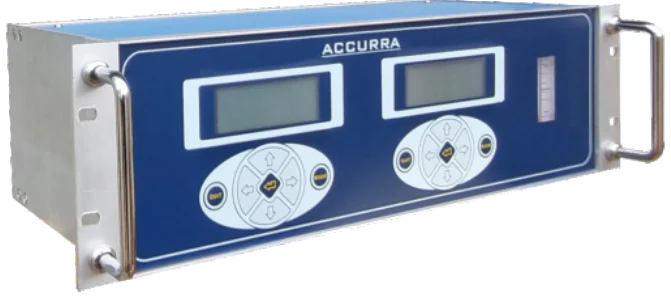
ACCURRA-S
Online analyser for trace, percent and purity O2, CO, CO2, CH4 and dew point; can measure two gases from one sample.
View ACCURRA-S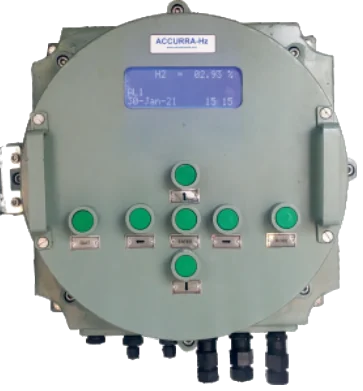
ACCURRA-Hz
Process gas analyser in an enclosure certified for Gas Group IIC, Zone 1 and 2, T6.
View ACCURRA-HzHeadline filters
Particulate, coalescing and PTFE membrane filters from Headline Filters, UK, for analyser protection.
View Headline filtersFrequently asked questions
Does ACCURRA-TCD need a reference gas?
No. It has no sealed reference and needs no continuous flow of reference gas.
What gases can it measure?
H2, He, Ar, N2, N2O, Ne and Kr in binary mixtures.
How fast does it respond?
T90 below 10 seconds at 0.6 LPM.
What if my sample has three components?
A third gas changes the thermal conductivity. Give us the composition and we will advise.
What sensor does it use?
A platinum thermal conductivity sensor.