
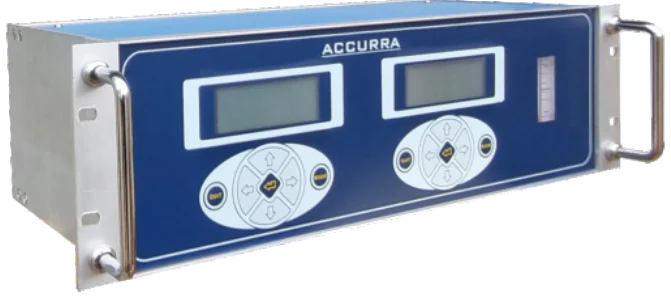
A dual-gas ACCURRA-S houses two sensors in one enclosure with common pneumatics, so two gases are measured from one sample. Each channel keeps its own electronics, 4-20 mA output, relays and Modbus ID, and a fault in one channel does not stop the other.
Specifications
| Item | Specification | Notes |
|---|---|---|
| O2 ppm + dew point | In N2, H2, Ar, He | |
| O2 ppm + CO ppm | In various background gases | |
| O2 ppm + CO2 ppm | ||
| O2 ppm + N2 % | In Ar, He | |
| O2 % + CO ppm | In various background gases | |
| O2 % + CO % | In your processes | |
| O2 % + CO2 % | In Ar, N2 | |
| CO ppm + CO2 ppm | In N2, Ar, He | |
| CO ppm + CO2 % | In your processes | |
| CO % + CO2 % | In your processes |
From the current Sarvesh product datasheets and company profile. Specifications may change without notice as products improve. The final responsibility to check that a product meets the process and analyser requirement remains with the customer.
Key features
- Independent electronics and microcontroller per sensor, so a fault in one channel does not affect the other
- Separate 4-20 mA output, set of relays and Modbus ID per channel
- Shared pneumatics: one sample inlet, one outlet, one fine filter
How it works
A dual-channel analyser saves panel space, tubing and cost compared with two separate analysers, and it reads both components on the same sample at the same moment. That matters when the ratio of two gases is the control variable, as with oxygen uptake and CO2 evolution in a fermenter, or oxygen and moisture as the two signs of air ingress.
Each channel is a full ACCURRA-S measurement with its own range, alarms and calibration. Not every combination is available with every option: for example, auto-calibration is not available on 3015 and M015, and models 3130 and 3190 take no internal pump.
Requirements and limits
- Safe-area analyser; the same sample specification applies as for the single-gas models.
On site: utilities and calibration gases
What to have ready at your plant before installation and commissioning.
| Item | Requirement | Notes |
|---|---|---|
| Power at the analyser | 100 to 240 V AC, 50/60 Hz, 45 W | |
| Zero gas | Zero-grade nitrogen, 99.9999 % | 10 litre cylinder with regulator |
| Span gases | One span gas per channel, chosen for each channel's gas and range | Auto-calibration valves are external on dual-gas units |
| Instrument air and service nitrogen | 4 kg/cm² minimum | |
| Sample at the analyser | 2 to 10 psig, about 1 LPM, 5 to 45 °C, dust below 3 micron | Pressure and flow regulated by the user |
| Mounting | 19 inch rack or panel, in a safe area |
Selection guidance
Choose a dual-gas ACCURRA-S where two measurements share a sample. See the individual pages for CO and CO2 percent, CO2 and CH4, O2 and CO2, trace CO and CO2, and trace oxygen and moisture.
Applications
Application pages where this is part of the recommended solution:
- Fermenter and bioreactor off-gas
- Biogas and compressed biogas (CBG)
- Heat-treatment furnace atmosphere
- Nitrogen purity and trace oxygen
- Optical fibre and cable manufacturing
Compatible products
ACCURRA-S
Online analyser for trace, percent and purity O2, CO, CO2, CH4 and dew point; can measure two gases from one sample.
View ACCURRA-SACCURRA-TCD
Thermal conductivity analyser for binary mixtures of H2, He, Ar, N2 and others, with no reference gas.
View ACCURRA-TCDHeadline filters
Particulate, coalescing and PTFE membrane filters from Headline Filters, UK, for analyser protection.
View Headline filtersFrequently asked questions
How are the two channels connected?
They share the sample path, but each has its own electronics, outputs, relays and Modbus ID.
What happens if one sensor fails?
The other keeps measuring.
Can I mix any two gases?
The combinations listed in the catalogue are available; ask us about others.
Is there a price advantage?
One enclosure replaces two, saving panel space and tubing.