
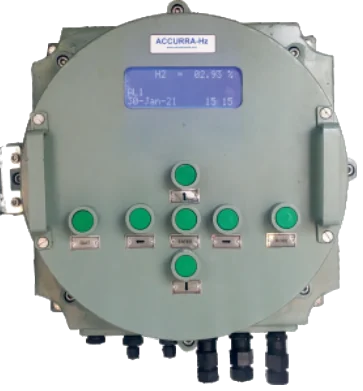
Reactors, hydrogenation and polymerisation use ACCURRA-Hz for trace oxygen, percent or purity hydrogen, and CO and CO2. The enclosure is certified for Gas Group IIC, Zone 1 and 2, T6, and calibration is possible without opening the covers.
The measurement and why it matters
Three process families dominate this page. Hydrogenation recycles hydrogen over a catalyst; oxygen is a safety hazard and a poison, and hydrogen purity affects yield. Polymerisation catalysts lose activity with a few ppm of oxygen. Merox sweetening injects air, so oxygen in the vent shows whether operation is safe.
ACCURRA-Hz measures trace oxygen in ppm, hydrogen as percent or purity using a TCD housing, and CO and CO2 from trace to percent. Calibration is possible without opening the covers, which avoids hot work for routine checks. The enclosure is certified for Gas Group IIC, Zone 1 and 2, T6 as per IS/IEC 60079-1:2014; ask us for current certificate copies.
Send the process gas composition, pressure and temperature so we can choose the sensor and conditioning.
Models and ranges
| Model | Measures | Range | Sensor and notes |
|---|---|---|---|
| ACCURRA-Hz | Trace oxygen | ppm | Hazardous-area enclosure |
| ACCURRA-Hz TCD housing | Hydrogen, percent or purity | Application specific | Thermal conductivity |
| ACCURRA-Hz | CO and CO2 | Trace to percent |
Process notes
Hydrogenation
Hydrogenation adds hydrogen to a feed over a catalyst, often under pressure and at elevated temperature. It is used for edible oils, fine chemicals, pharmaceutical intermediates and hydrocarbons. The loop recycles unreacted hydrogen, which collects impurities, and the whole system has to be freed of air before hydrogen goes in.
Two measurements do most of the work. Trace oxygen confirms the purge before start-up and warns of ingress during operation. Hydrogen purity in the recycle gas tells you when to purge impurities from the loop. Both normally sit in a classified area, so the analyser enclosure and installation have to match the zone.
Polymerisation
Polyolefin plants use Ziegler-Natta and metallocene catalysts that lose activity when exposed to oxygen, moisture and some other poisons. Monomer and nitrogen feeds are purified and then checked, because a few ppm of oxygen changes catalyst yield and polymer properties.
A trace oxygen analyser on the purified feed and nitrogen lines gives immediate warning of breakthrough or leaks, so the operator can switch beds before the reactor sees the contamination. Where the plant classifies the area, the analyser goes in a certified enclosure.
For selection, give us the carrier gas, the expected oxygen level, line pressure and the area classification. Electrochemical cells need a steady flow within range, and ACCURRA-S includes a flow indicator and fine filter in the analyser. Verify the zero with oxygen-free gas after installation, since a trace measurement is only as good as its zero.
Merox units
Merox sweetening converts mercaptans in LPG, naphtha and kerosene into disulfides, using air and a catalyst in an alkaline solution. The air must be controlled. Too little leaves the product sour, and too much carries oxygen into places where hydrocarbon vapour is present.
Oxygen readings in the vent or off-gas help set air flow and confirm safe operation. The sample can be wet and carry hydrocarbon aerosol, so it needs coalescing and membrane filtration before the analyser. Installation is almost always in a classified area.
Please tell us the stream you want to measure, its pressure and temperature, the presence of hydrocarbon liquids, and the zone classification. We will recommend between a panel analyser and a field transmitter, and design the conditioning around the actual sample. Headline coalescing and membrane filters are available to protect the cell from liquid carry-over.
Sampling and installation
- Send the process gas composition, pressure and temperature so we can choose sensor and conditioning. Ask us for current certificate copies.
- Use materials suited to hydrogen service and to any sulphur compounds present.
- Provide a safe vent for the analyser exhaust.
- Use leak-tight fittings at ppm level; every joint is a leak path.
Send us your process data
The same pre-order design inputs our engineers design from, online. Fill in what you know, leave the rest. Your draft saves as you go, and you can print or send it when ready.
What the data sheet asks for
Send what you have and we will ask for the rest.
- The gases to measure, the range, and the accuracy you need
- Background gases and their typical composition
- Sample temperature, pressure and dew point at the tapping point
- Dust level, and whether the gas carries tar, oil or condensable vapour
- Process connection and, for ducts, the duct diameter
- Where the sample vents to, and at what pressure
- Area classification of the tapping point and of the analyser location, and the IP protection needed
- Distance between the tapping point and the analyser
- Outputs you need: 4-20 mA, dual range, relays, Modbus RTU
- Calibration approach, calibration gas available, and whether blowback is required
- Utilities at site: power supply, instrument air, nitrogen, steam and cooling water, and the ambient temperature range
- Area classification, gas group, temperature class and whether certificates are required
Recommended Sarvesh products
ACCURRA-Hz
Hazardous-area analysers.
View ACCURRA-HzACCURRA-TCD
Hydrogen purity.
View ACCURRA-TCD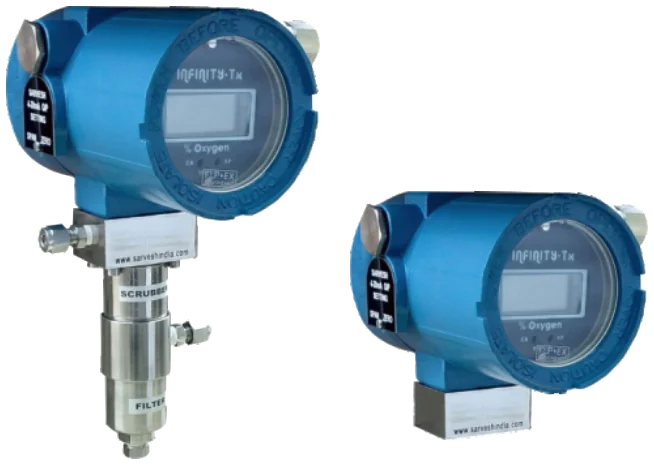
INFINITY-Tx
Loop-powered transmitter.
View INFINITY-TxHeadline filters
Coalescing and membrane filters.
View Headline filtersFrequently asked questions
What area classification does ACCURRA-Hz meet?
Gas Group IIC, Zone 1 and 2, T6, as per IS/IEC 60079-1:2014. Ask us for current certificate copies.
Can I calibrate without opening the cover?
Yes.
Can it handle sulphur compounds?
Some sensors are attacked by sulphur compounds. Describe the stream and we will propose a compatible sensor and conditioning.
Which analyser for polymerisation feed?
ACCURRA-S for safe areas and ACCURRA-Hz where the area is classified, with a trace oxygen range of 0 to 100 or 0 to 1000 ppm.
More in Pharma, chemicals and petrochemicals
- Nitrogen blanketing and inerting
- Closed-loop dryers and spray dryers
- Fermenter and bioreactor off-gas
- Pyrolysis, gasification and syngas
- Autoclaves
- Flare-gas recovery oxygen ingress
- Dust-collector, mill and silo inerting
- Solvent-recovery and distillation columns under inert gas
- All pharma, chemicals and petrochemicals applications
- Browse analysers by gas