
A thermal conductivity analyser works well on hydrogen or helium against any heavier gas, and moderately on argon or nitrous oxide against nitrogen. It cannot separate nitrogen, oxygen and carbon monoxide, or argon, carbon dioxide and nitrous oxide.
Pairs by suitability
| Mixture | Fit | Why |
|---|---|---|
| Hydrogen in nitrogen, oxygen, argon or air | Excellent | Hydrogen conducts about seven times better than the other gas |
| Helium in nitrogen, oxygen, argon or air | Excellent | Helium conducts about six times better |
| Hydrogen in helium (or the reverse) | Marginal | Both conduct heat well and are close to each other |
| Argon in helium or hydrogen | Excellent | Large conductivity gap |
| Nitrogen in helium or hydrogen | Excellent | Large conductivity gap |
| Argon in nitrogen | Good | Argon conducts about a third less than nitrogen |
| Nitrous oxide in helium or hydrogen | Good | Large conductivity gap |
| Nitrous oxide in nitrogen or oxygen | Fair | Moderate gap; needs a narrow range |
| Nitrous oxide in carbon dioxide or argon | Poor | Conductivities are close |
| Nitrogen in oxygen, air or carbon monoxide | Not suitable | Conductivities are nearly identical |
| Any mixture with a varying third gas | Review needed | A third component shifts the reading |
From the current Sarvesh product datasheets and company profile. Specifications may change without notice as products improve. The final responsibility to check that a product meets the process and analyser requirement remains with the customer.
Key features
- Hydrogen, helium, argon, nitrogen, nitrous oxide, neon and krypton are the gases ACCURRA-TCD lists
- Repeatability below 1 percent of full scale, linearity below 1 percent of range, errors and drift below 1 percent of full scale per week; T90 below 10 s at 0.6 LPM
- Range chosen from the conductivity gap, so a small gap is measured on a narrow range
How it works
The signal from a thermal conductivity analyser scales with the difference in conductivity between the two gases and with the concentration of the variable one. A wide gap gives a strong signal and a wide usable range. A narrow gap gives a weak signal, so only a narrow range is practical and the sample must be steady in flow and temperature.
Mixtures that contain three or more components need care. If the extra component is constant, we calibrate with it in place and the analyser behaves as a binary one. If it varies, for example water vapour in a furnace atmosphere, the reading drifts, so the sample is dried or the variation is accounted for. Give us the complete composition, with typical and extreme values.
Where the gas you want has no useful conductivity difference from the background, use a different method. Oxygen, carbon monoxide, carbon dioxide and methane are measured by ACCURRA-S with electrochemical, paramagnetic and NDIR sensors.
Requirements and limits
- Fit ratings above are indicative and depend on range and accuracy required; confirm for your mixture.
Selection guidance
Send the two gases, the range you need to read, any other components and their variation, and the sample temperature, pressure and moisture. We will confirm the fit and the range.
Applications
Application pages where this is part of the recommended solution:
- Hydrogen purity
- Float glass bath atmosphere
- Welding and laser gas mixtures
- Gas purity certification and cylinder filling
Compatible products
ACCURRA-TCD
Thermal conductivity analyser for binary mixtures of H2, He, Ar, N2 and others, with no reference gas.
View ACCURRA-TCD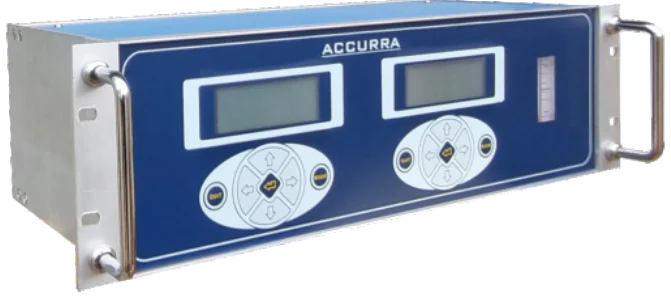
ACCURRA-S
Online analyser for trace, percent and purity O2, CO, CO2, CH4 and dew point; can measure two gases from one sample.
View ACCURRA-SHeadline filters
Particulate, coalescing and PTFE membrane filters from Headline Filters, UK, for analyser protection.
View Headline filtersFrequently asked questions
Can I measure hydrogen in helium?
It is marginal because both conduct heat well. Tell us your range and we will advise.
Can I measure argon in a CO2 blend?
Argon and carbon dioxide are close in conductivity; NDIR on ACCURRA-S measures the CO2 directly.
What if my sample has water vapour?
Water vapour changes the conductivity. Dry the sample, or tell us the moisture so we can account for it.
Can you measure neon and krypton?
They are on the ACCURRA-TCD gas list; please send the mixture and range.