
A thermal conductivity analyser measures a gas by how fast it carries heat away from a heated element. It suits binary mixtures where the gases differ, such as hydrogen or helium in anything heavier. ACCURRA-TCD uses a platinum sensor and needs no reference gas.
Approximate thermal conductivity of common gases
| Gas | Thermal conductivity | Relative to nitrogen |
|---|---|---|
| Hydrogen | about 180 mW/m.K | about 7 times |
| Helium | about 150 mW/m.K | about 6 times |
| Neon | about 49 mW/m.K | about 1.9 times |
| Methane | about 34 mW/m.K | about 1.3 times |
| Nitrogen | about 26 mW/m.K | 1 (reference) |
| Oxygen | about 26 mW/m.K | about 1 |
| Carbon monoxide | about 25 mW/m.K | about 1 |
| Argon | about 18 mW/m.K | about 0.7 |
| Nitrous oxide | about 17 mW/m.K | about 0.7 |
| Carbon dioxide | about 17 mW/m.K | about 0.65 |
| Krypton | about 9 mW/m.K | about 0.35 |
From the current Sarvesh product datasheets and company profile. Specifications may change without notice as products improve. The final responsibility to check that a product meets the process and analyser requirement remains with the customer.
Key features
- Responds to the bulk composition of the gas, not to a specific chemical reaction
- Very sensitive to hydrogen and helium, which conduct heat far better than other gases
- Platinum sensing element in ACCURRA-TCD; no reference gas required
- Suited to binary mixtures of known background
How it works
Inside the analyser, a heated element sits in a small cell through which the sample flows. The gas carries heat away from the element at a rate set by its thermal conductivity, and the electrical balance needed to hold the element at temperature becomes the signal. Hydrogen in nitrogen, for example, raises the heat loss strongly, so even a small hydrogen change gives a large, clean signal.
The table shows approximate values at room temperature. What matters in practice is the difference between the two gases in your mixture. Hydrogen or helium against any heavier gas is a large difference and an excellent fit. Nitrogen, oxygen and carbon monoxide are almost identical, so a TCD cannot tell them apart. Argon, carbon dioxide and nitrous oxide are also close to each other.
Many thermal conductivity analysers compare the sample against a reference gas, which means a second cylinder, a regulator and a running cost. ACCURRA-TCD is built so that no reference gas is needed. Conductivity also changes with temperature and flow, so the sample is conditioned to steady temperature and flow and filtered before the sensor.
Requirements and limits
- Binary mixtures only. A varying third component, including water vapour, shifts the reading.
- Nitrogen, oxygen and carbon monoxide cannot be separated from one another by thermal conductivity.
Selection guidance
Use thermal conductivity when the gas you want is hydrogen, helium, argon or nitrogen in a known binary mixture. Use ACCURRA-S for oxygen, carbon monoxide, carbon dioxide, methane and moisture, which are measured by electrochemical, paramagnetic, NDIR and ceramic sensors.
If your sample has a third component that varies, tell us the full composition. A third gas shifts the reading, and sometimes a different method is the better answer.
Applications
Application pages where this is part of the recommended solution:
- Hydrogen purity
- Electrolyser safety and quality
- Float glass bath atmosphere
- Heat-treatment furnace atmosphere
- Gas purity certification and cylinder filling
- Welding and laser gas mixtures
- Aerospace, nuclear and research laboratories
Compatible products
ACCURRA-TCD
Thermal conductivity analyser for binary mixtures of H2, He, Ar, N2 and others, with no reference gas.
View ACCURRA-TCD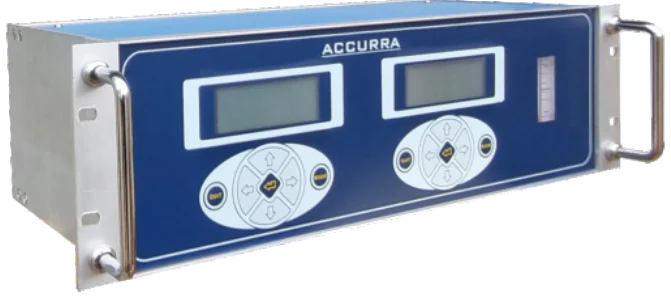
ACCURRA-S
Online analyser for trace, percent and purity O2, CO, CO2, CH4 and dew point; can measure two gases from one sample.
View ACCURRA-SHeadline filters
Particulate, coalescing and PTFE membrane filters from Headline Filters, UK, for analyser protection.
View Headline filtersFrequently asked questions
How does a thermal conductivity analyser work?
A heated element sits in the sample. The gas carries heat away at a rate set by its thermal conductivity, and that change is the signal.
Does ACCURRA-TCD need a reference gas?
No.
Which gases can it not separate?
Gases with similar thermal conductivity, for example nitrogen, oxygen and carbon monoxide, or argon, carbon dioxide and nitrous oxide.
Why is hydrogen so easy to measure this way?
Hydrogen conducts heat about seven times better than nitrogen, so small concentrations give a large signal.