
ACCURRA-TCD is used for hydrogen purity, electrolyser gas quality, float glass and annealing atmospheres, helium and argon purity, gas blends and research rigs: any binary mixture where the main component must be measured without a reference gas.
Applications at a glance
| Application | What ACCURRA-TCD measures | Notes |
|---|---|---|
| Hydrogen purity | Hydrogen in a known background | Production, filling and process monitoring |
| Electrolyser gas quality | Hydrogen in oxygen; hydrogen purity | Alarms set from the safety study; hazardous-area options |
| Float glass bath | Hydrogen in nitrogen | Clean binary mixture, dry sample |
| Heat treatment atmospheres | Hydrogen in nitrogen | Annealing and bright treatment lines |
| Cylinder filling and certification | He, Ar, N2 or H2 purity | Binary purity checks |
| Welding and laser blends | Ar, He or N2 binary blends | Three-component blends need review |
| Research laboratories | H2, He, Ar, N2, N2O, Ne, Kr | Set-up reviewed per rig |
From the current Sarvesh product datasheets and company profile. Specifications may change without notice as products improve. The final responsibility to check that a product meets the process and analyser requirement remains with the customer.
Key features
- No reference gas, so no extra cylinder or regulator
- Platinum thermal conductivity sensor
- Isolated 4-20 mA with programmable range, programmable alarms and Modbus RTU
- Repeatability and linearity below 1 percent; T90 below 10 seconds at 0.6 LPM
How it works
Hydrogen is where ACCURRA-TCD is most used. Production plants, filling stations and process loops all need hydrogen purity, and the hydrogen in oxygen reading around electrolysers is a safety measurement as well as a quality one. Reducing atmospheres in float glass baths and annealing furnaces use hydrogen in nitrogen, a mixture that suits thermal conductivity well.
Helium and argon purity follow the same logic. A helium or argon plant checks the product by measuring the main component against its known balance gas, and welding and laser gas blenders check binary blends. Research rigs use the analyser for any of the gases on its list.
Each application has its own conditioning and area needs. Electrolyser and reactor locations are classified, and flammable hydrogen samples need installation review. Where the area is classified, see ACCURRA-Hz for hydrogen measurement in certified enclosures.
Requirements and limits
- Binary mixtures only; flammable hydrogen samples need installation and area review.
Selection guidance
Open the application page nearest your process, or send us the mixture, range and area classification.
Applications
Application pages where this is part of the recommended solution:
- Hydrogen purity
- Electrolyser safety and quality
- Float glass bath atmosphere
- Heat-treatment furnace atmosphere
- Gas purity certification and cylinder filling
- Welding and laser gas mixtures
- Aerospace, nuclear and research laboratories
- Steel plant process gases
Compatible products
ACCURRA-TCD
Thermal conductivity analyser for binary mixtures of H2, He, Ar, N2 and others, with no reference gas.
View ACCURRA-TCD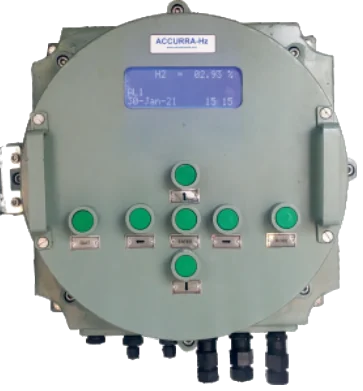
ACCURRA-Hz
Process gas analyser in an enclosure certified for Gas Group IIC, Zone 1 and 2, T6.
View ACCURRA-HzHeadline filters
Particulate, coalescing and PTFE membrane filters from Headline Filters, UK, for analyser protection.
View Headline filtersFrequently asked questions
What is ACCURRA-TCD used for?
Measuring hydrogen, helium, argon, nitrogen, nitrous oxide, neon or krypton in binary gas mixtures without a reference gas.
Is it available for hazardous areas?
ACCURRA-Hz covers hydrogen measurement in certified enclosures; send your classification.
Can it measure oxygen or CO2?
No. Use ACCURRA-S for oxygen, CO, CO2, methane and moisture.
How do I choose a range?
From the conductivity difference between the two gases and the concentration you need to read. Send the mixture and we will advise.