
A wet-basis reading counts water vapour as part of the gas; a dry-basis reading removes it. Because water takes up part of the volume, a wet-basis oxygen value is lower than the dry-basis value for the same gas. In-situ analysers read on a wet basis, extractive analysers that dry the sample read on a dry basis, and limits are usually dry.
- Explain dry and wet basis and when each applies
- Convert an oxygen reading between wet and dry
- State which analyser types read on which basis
Water is a gas component too
Flue gas, biogas and fermentation off-gas all carry water vapour, often 5 to 20 % by volume. When a sensor measures oxygen as a share of all molecules in the gas, water is part of the denominator. If you remove the water first, the denominator shrinks and the oxygen share rises.
Converting between them
dry value = wet value / (1 - water fraction)
A hot flue gas reads 2.7 % oxygen in situ and holds 10 % water vapour. The dry-basis oxygen is 2.7 / (1 - 0.10) = 3.0 %. The gas is the same; only the counting basis changed.
This is why a boiler operator who compares an in-situ zirconia reading with a dry extractive reading from the same duct sees a difference even when both instruments are right.
Which analysers read which basis
- In-situ analysers such as zirconia read wet: they see the gas as it is, with its water.
- Extractive analysers that cool the sample to a low dew point before measuring read dry, to the extent that the water is removed. A Peltier cooler holds the gas at a fixed dew point rather than removing all water.
- Hot-wet extractive systems keep the sample hot and measure wet, then correct if a dry value is needed.
Check which basis a specification means, and which basis your instrument reports. Environmental limits are normally stated dry.
Why it matters for control and compliance
- Combustion trim uses oxygen; changing the water content of the fuel changes a wet reading even when the burner air is unchanged.
- Excess-air formulas assume dry oxygen: Excess air from flue gas oxygen calculator.
- Emission values are corrected to dry and to a reference oxygen: Emission correction to reference oxygen.
- Water vapour is part of the gas volume; dry basis removes it.
- Wet-basis oxygen is lower than dry-basis oxygen for the same gas.
- dry = wet / (1 - water fraction).
- In-situ reads wet; a cooled extractive sample reads dry.
Check your understanding
Answer in your head or on paper first, then open the answer. Recalling an answer teaches more than rereading.
A flue gas has 8 % water vapour and reads 4.6 % oxygen wet. What is the dry value?
4.6 / 0.92 = 5.0 %.
Why do in-situ and extractive oxygen readings on the same duct differ?
In-situ reads on a wet basis and the extractive instrument reads after drying, so the water share changes the value.
What basis do emission limits normally use?
Dry basis, and a stated reference oxygen.
Key terms
Frequently asked questions
Is oxygen higher or lower when measured wet?
Lower, because the water vapour takes up part of the volume.
How much water is in flue gas?
Commonly 5 to 20 % by volume depending on the fuel. Gas-fired plants carry more than coal-fired.
Do dry-gas analysers see water?
A cooled sample still holds water at the cooler's dew point, which is usually a few percent or less.
Can I measure moisture in the same sample?
Only if the sample is kept above its dew point, which is a different sample system from a cooled dry one.
Related products
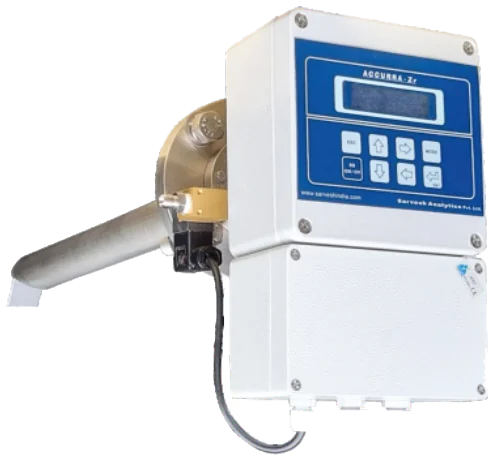
ACCURRA-Zr
Zirconia percent O2 analyser for furnaces and boilers, single-point air calibration, options to 1400 C.
View ACCURRA-Zr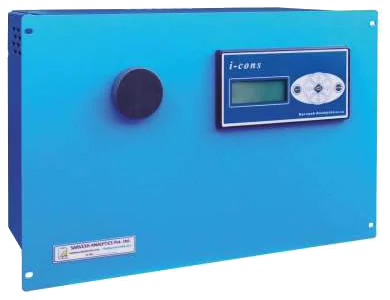
i-Cons
Smart Peltier sample conditioner with diagnostics, auto blowback and Modbus, in a compact 19 inch cabinet.
View i-Cons