Accuracy is how close a reading is to the true value; precision or repeatability is how closely repeated readings agree; drift is how the reading moves over time. A specification of plus or minus 1 % of span allows the same absolute error everywhere on the range, so it is a large share of a small reading. Percent of reading scales with the value.
- Define accuracy, precision, repeatability, resolution, linearity and drift
- Read a percent-of-span specification and compute the absolute error
- Distinguish zero drift from span drift and say what causes each
The vocabulary
| Term | Meaning |
|---|---|
| Accuracy | Closeness of the reading to the true value. |
| Precision, repeatability | How closely repeated readings of the same gas agree. |
| Resolution | The smallest change the display or output can show. |
| Linearity | How closely the response follows a straight line across the range. |
| Drift | Change in reading over time with the same gas: zero drift at zero gas, span drift at the span gas. |
| Detection limit | The smallest concentration that can be distinguished from zero. |
An instrument can be precise but not accurate, such as a clock that is always five minutes fast. Calibration corrects the offset; it cannot fix a noisy instrument.
Percent of span vs percent of reading
A specification of plus or minus 1 % of span (full scale) allows the same absolute error everywhere in the range. On a 0 to 1000 ppm range that is plus or minus 10 ppm whether the gas is at 900 ppm or at 20 ppm. At 20 ppm the error is 50 % of the reading.
A specification of plus or minus 1 % of reading scales with the value: at 20 ppm it allows 0.2 ppm. Percent of reading is the tighter promise near the bottom of the range.
Choose a range so that your normal reading sits in the upper half. If the process runs at 5 ppm on a 0 to 1000 ppm range, the specification gives you little. Ask for a narrower range, such as 0 to 100 ppm.
Drift: why calibration exists
Sensors age and their electronics move with temperature. Zero drift shifts every reading by the same amount; span drift scales them. Both are corrected by calibration with zero and span gas, and the rate of drift sets how often to calibrate: How often should you calibrate a gas analyser.
Drift specifications state the change over a period, for example per week or per month, under stated conditions. A low drift figure means the analyser holds a calibration longer.
What accuracy figure is realistic
The accuracy of the instrument is only part of the total. The calibration gas has its own uncertainty, the sample can change on the way, and ambient temperature and pressure affect the sensor. A stated accuracy is for the analyser under specified conditions, not a guarantee of the final reading. The lesson on how much accuracy you really need explains how to budget these: What accuracy do you really need from a gas analyser.
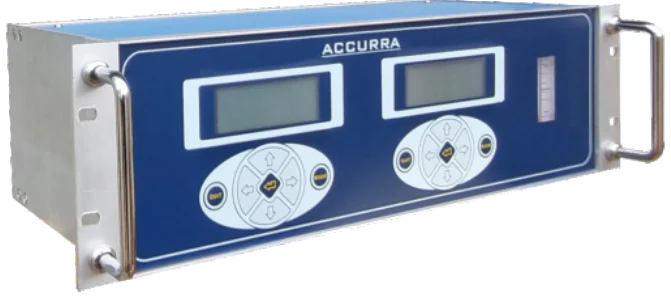
For example, the catalogue gives ACCURRA-S M015 dew point accuracy of plus or minus 2 C with repeatability of 1 C. Ask for the figures that apply to your model and range.
- Accuracy is closeness to truth; precision is agreement between repeats; drift is change over time.
- Percent of span is the same absolute error everywhere; percent of reading scales with the value.
- Operate in the upper half of the range for best use of a span specification.
- Calibration corrects offset and scale, not noise.
Check your understanding
Answer in your head or on paper first, then open the answer. Recalling an answer teaches more than rereading.
An analyser on 0 to 500 ppm is specified plus or minus 2 % of span. What is the error at a reading of 50 ppm, as a percent of the reading?
Plus or minus 10 ppm is 20 % of 50 ppm.
What does calibration correct, and what can it not correct?
It corrects zero offset and span scale. It cannot make a noisy or unstable instrument repeatable.
Zero drift or span drift: which shifts every reading by the same amount?
Zero drift.
Key terms
Frequently asked questions
What is the difference between accuracy and precision?
Accuracy is how close to the true value; precision is how close repeated readings are to each other.
What does plus or minus 1 % of span mean?
The error can be up to 1 % of the full-scale value anywhere on the range.
What is resolution?
The smallest step the instrument can display, which is not the same as its accuracy.
Why does an analyser drift?
Sensor ageing and temperature effects on the sensor and electronics.