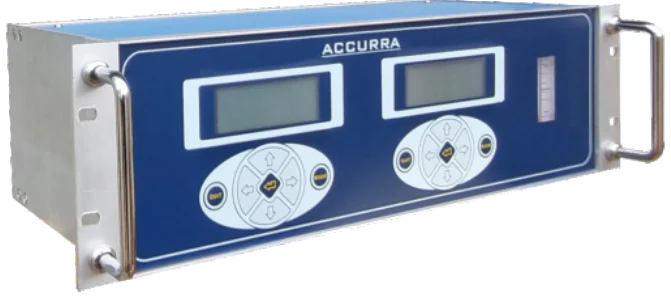
Read a datasheet in four groups: what it measures (gas, range, minimum range), how well (accuracy, repeatability, drift, response), what it needs (sample conditions, power, utilities, ambient limits) and what it gives (outputs, approvals, options). The sample conditions and the footnotes tell you most about whether it will work on your process.
- Group datasheet lines into measurement, performance, needs and outputs
- Spot the conditions behind each figure
- List the questions a datasheet leaves unanswered
1. What it measures
- Gas and principle: which gas, and by which sensor technology.
- Range and minimum range: for example 0 to 1000 ppm with a minimum of 0 to 100 ppm. A minimum range is the narrowest span you can configure.
- Number of channels: whether it can measure two gases from one sample.
2. How well
- Accuracy: check whether it is percent of span or percent of reading, and at what conditions. See Accuracy, precision, repeatability and drift in gas analysers.
- Repeatability and drift: drift over what period?
- Response time: T90 at what flow rate? See Response time, T90 and sample lag in gas analysis.
- Compensation: pressure and temperature compensation for purity measurement.
Percent of reading or percent of full scale: a worked example
The same words, accuracy and range, hide very different numbers. Two lines from the ACCURRA-S datasheet show why the basis matters.
| Model | Datasheet accuracy | At a low reading | At a high reading |
|---|---|---|---|
| 3015 trace oxygen, 0 to 1000 ppm | 1 % of reading +/- 2 ppm | At 10 ppm: +/- 2.1 ppm, about 21 % of the reading | At 500 ppm: +/- 7 ppm, 1.4 % of the reading |
| 2030 carbon monoxide, 0 to 100 % | 2 % of full scale | At 10 % CO: +/- 2 % CO, 20 % of the reading | At 80 % CO: +/- 2 % CO, 2.5 % of the reading |
A full-scale figure is a fixed band in absolute units, so it weighs most at the bottom of the range. A reading-based figure shrinks with the reading, but most trace sensors add a fixed term, here 2 ppm, that dominates near zero. Work out the band at the value where your process actually runs, not at full scale.
A nitrogen plant certifies product below 10 ppm oxygen. On 3015 the band at 10 ppm is about +/- 2 ppm. A release limit of 10 ppm therefore needs a reading of about 8 ppm or less to be sure, before calibration gas and drift are added. See What accuracy do you really need from a gas analyser.
Repeatability, drift and response, read properly
Repeatability is how closely the analyser agrees with itself on the same gas. It is the figure that matters for alarms and trends, because an offset can be calibrated away but scatter cannot. ACCURRA-S 3130 states +/- 0.1 % of full scale; 3015 states zero +/- 2 ppm and span 1 % of reading.
Drift needs a time base. ACCURRA-TCD states drift below 1 % of full scale per week. On a 0 to 3 % hydrogen range that is up to 0.03 % hydrogen a week, which tells you how often to check it, see How often should you calibrate a gas analyser.
Response needs a flow. ACCURRA-S 3130 and 3190 state a T90 below 5 seconds at 1 LPM; 3015 below 30 seconds; the dew point model M015 about 2 minutes from dry to wet at 5 LPM. These are sensor figures. The sample line adds its own lag on top: Response time, T90 and sample lag in gas analysis.
Comparing two analysers' T90 when one was measured at 1 LPM and the other at a higher flow, or one at the sensor and the other at the inlet. Ask for the conditions.
3. What it needs
- Sample conditions: pressure, flow, temperature, and what the sample may contain. For ACCURRA-S the catalogue states a non-corrosive, non-toxic, non-flammable, non-condensing, dry, oil-free sample at 2 to 10 psig and about 1 LPM, dust below 3 micron.
- Internal pump or not: some models are supplied without one, which suits a pressurised sample but not an ambient one.
- Power and utilities: supply voltage, consumption, any air or gas needed.
- Ambient limits and enclosure: temperature range, IP rating, area classification.
The sample limits are the real specification
The sample section is where a datasheet tells you what will go wrong. The ACCURRA-S datasheet asks for a sample at 5 to 45 C, with a dew point at least 5 C below the lowest ambient temperature, dust below 3 micron, 2 to 10 psig regulated externally and about 1 LPM. It lists the wetted materials: SS316, Viton, PTFE, glass, aluminium and acrylic. A gas that attacks any of them needs a different design.
The options section carries limits too. On ACCURRA-S, auto-calibration is not available on 3015 and M015, an internal sample pump is not available on 3015, M015, 3130, 3190 or any dual-gas unit, and choosing the pump takes away the range ID relay. Read those notes before you assume a combination exists.
4. What it gives
- Outputs: 4-20 mA, relays, Modbus RTU, display.
- Alarms and diagnostics: relays, fault outputs, stored calibration and alarm history.
- Approvals: hazardous-area certification states zone, gas group and temperature class.
- Options: auto-calibration, blowback, heated lines.
A figure without conditions is a marketing number. Look for the footnote that gives the temperature, flow and gas it was measured under.
Questions a datasheet usually leaves open
- Will my sample stay inside the stated sample conditions all year?
- Is the accuracy at the part of the range where my process runs?
- How is the analyser calibrated on site, and with what gas?
- What do the outputs do on a fault?
- What spares and sensor life should I plan for?
Those questions are why the application data sheet exists: The application data sheet: what to send Sarvesh.
Standards behind the words
IEC 61207-1 sets out how gas analyser performance should be expressed: the meaning of accuracy, repeatability, linearity, drift and response time, and the conditions under which they are stated. Further parts cover particular principles, for example IEC 61207-3 for paramagnetic oxygen analysers. When two suppliers use the same word differently, the standard's definition settles it.
IEC 60079 marks the hazardous-area approval, for example Gas Group IIC, T6 to IS/IEC 60079-1:2014 for ACCURRA-Hz: Hazardous area gas analysers explained. IEC 60529 defines the IP code: ACCURRA-S is IP 20 for indoor rack or panel mounting; ACCURRA-Hz and the ACCURRA-Zr head are IP 66.
If a figure has no condition and no standard behind it, ask for both before you compare it with anything.
- Group lines: what it measures, how well, what it needs, what it gives.
- Check whether accuracy is of span or of reading, and the conditions behind it.
- Sample conditions and ambient limits decide whether it works on your plant.
- Ask about calibration, fault outputs and spares.
Check your understanding
Answer in your head or on paper first, then open the answer. Recalling an answer teaches more than rereading.
What is a minimum range?
The narrowest span the analyser can be configured to, such as 0 to 100 ppm on a 0 to 1000 ppm model.
Why does an internal pump matter?
A model without one needs a pressurised sample. An ambient sample needs a pump.
Where on a datasheet do you find the sample the analyser can accept?
The sample conditions: pressure, flow, temperature, cleanliness and composition limits.
Key terms
Frequently asked questions
What is the most important line on a gas analyser datasheet?
The sample conditions. An analyser outside them will not perform as stated.
What does IP rating tell me?
How well the enclosure keeps out dust and water, for example IP65.
Are datasheet figures guaranteed on my plant?
They apply under the stated conditions. Your sample and installation can change them, so ask.
Where do I find the ACCURRA-S datasheet?
On the downloads page of this website.