T90 is the time an analyser takes to reach 90 % of a step change in concentration. The total delay before a reading changes is the sample line lag plus the analyser's own T90. Lag equals line volume at line pressure divided by flow, so a short, narrow, low-pressure line is fast. Sticky gases such as moisture are slower still.
- Define T90 and explain why 90 % is used
- Split total delay into sample lag and analyser response
- Estimate lag from tube size, length, flow and pressure
- Name the ways to make a measurement faster
T90: the analyser's own speed
If you switch a sensor from one gas to another, the output rises along a curve. T90 is the time to reach 90 % of the final change. The full change takes theoretically forever, so the time to 90 % is the practical measure of speed. T95 and T99 exist for slower settling.
Sample lag: the delay before the gas arrives
Before the sensor can respond, the new gas has to get to it. The time is the volume in the sample line divided by the flow.
lag = line volume x (P_abs / P_atm) / flow
A 10 m line of 4 mm bore holds about 126 mL. At 1 L/min at atmospheric pressure the lag is 7.5 seconds. If the line is at 6 bar gauge it holds seven times more gas and the lag is about 52 seconds.
Add them up
The delay seen by an operator is lag plus T90 plus any filtering applied in the controller. If a process takes minutes to react, a 30 second delay may not matter. If an interlock must trip within seconds, it matters a great deal, and the specification must say so.
Quoting the analyser's T90 as if it were the system response. The sample line often dominates.
Moisture and sticky gases are slower
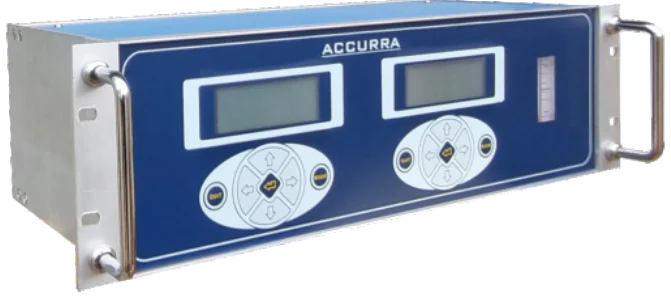
Water, ammonia and some other gases stick to surfaces. A dry gas passing through a new line is partly absorbed by the walls until they reach equilibrium, which slows and biases the reading. The catalogue figure for ACCURRA-S M015 is about 2 minutes from dry to wet at 5 LPM, and settling from wet to dry takes longer. Use stainless steel and short lines for moisture: Sample lines: materials, length, diameter and lag.
Ways to be faster
- Shorten the line and use a smaller bore.
- Reduce pressure close to the tapping with a regulator, so most of the line runs near atmospheric pressure.
- Use a fast bypass loop so a large flow passes the tapping and the analyser takes a small slice: Sample pressure, flow and fast bypass loops.
- Avoid dead legs and oversized filter bowls, which add volume.
- Choose a sensor with a faster T90 if the application needs it.
- T90 is the time to 90 % of a step change.
- Total delay = sample lag + analyser T90 + any filtering.
- Lag = line volume at line pressure divided by flow.
- Pressure dominates lag; reduce it near the tapping.
Check your understanding
Answer in your head or on paper first, then open the answer. Recalling an answer teaches more than rereading.
What does T90 measure?
The time for the output to reach 90 % of a step change in concentration.
A line is moved from 1 bar to 6 bar gauge with the same flow. What happens to lag?
It rises roughly seven times because the line holds seven times as much gas by volume at atmospheric equivalent.
Why is moisture reading slow in a new plastic line?
The tube walls absorb and release water until they equilibrate, so the sensor sees a delayed and biased value. Use stainless steel.
Key terms
Frequently asked questions
What is a good T90 for a gas analyser?
It depends on the sensor and gas. Process control often needs seconds to a minute; ask for the T90 at your flow and range.
Is T90 the same as response time?
T90 is the usual way to quote response time. Some datasheets use T95 or T63 instead.
Why is my reading slower than the datasheet T90?
The datasheet describes the analyser alone. Your sample line adds lag in front of it.
Can software speed up a reading?
Not the physical delay. Filters in the control system make it smoother and slower, not faster.