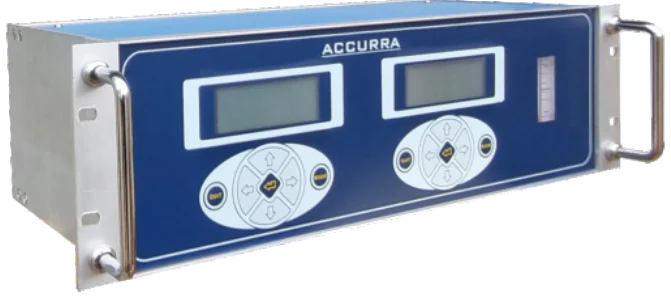
Online gas analysis measures the composition of a process gas continuously, as it flows, and sends the result to a display, an alarm or a control system. It replaces periodic sampling and laboratory tests with a live number, so a plant can control, protect and certify its process in real time.
- Define online gas analysis and name its three jobs: control, protection and certification
- Describe the parts of an analysis system from tapping to output
- Say what an online analyser cannot tell you
What an online analyser does
A process gas analyser draws or receives a small stream of gas, measures one or more components of it, and turns the result into a signal: a number on a screen, a 4-20 mA current, a relay that trips an alarm, or digital data over Modbus. It does this continuously for months, usually unattended.
The thing it measures is a concentration: how much of a target gas there is in the mixture. That can be a percentage (oxygen in flue gas), a few parts per million (trace oxygen in nitrogen) or a temperature at which moisture condenses (dew point). The next lessons deal with those units in detail.
Three jobs: control, protection, certification
- Control. The reading feeds a controller that adjusts the process. Flue gas oxygen trims a burner; hydrogen in a furnace atmosphere sets a gas valve.
- Protection. The reading triggers an alarm or an interlock before something goes wrong. Oxygen rising in a blanketed tank, or carbon monoxide rising in front of a filter, warns before a hazard develops.
- Certification. The reading proves product quality. A cylinder of oxygen or a tanker of nitrogen is sold on its purity, and the analyser result is the evidence.
Most installations do more than one of these. The job decides how fast the reading must be, how accurate, and how much it matters if the analyser is wrong, which in turn decides the specification.
The chain from process to signal
- Tapping. A point on the pipe, duct or vessel from which gas is taken.
- Sample line and conditioning. Tubing, filters, a cooler to remove water, a regulator for steady pressure and a flow meter. This part cleans and stabilises the sample.
- Sensor. The part that responds to the target gas: an electrochemical cell, a paramagnetic cell, an infrared bench, a thermal conductivity cell, a zirconia cell or a moisture sensor.
- Electronics and outputs. Convert the sensor signal to a reading and send it on.
Some analysers skip the sample line and measure in the pipe or duct itself. That is called in-situ measurement; see Extractive vs In-Situ gas analysis.
The sample system is not an accessory. In practice most field problems come from the sample reaching the sensor changed, not from the sensor. The sampling track of Learn is about exactly that.
What an online analyser cannot tell you
- Everything in the gas. Each analyser measures the gases it was chosen for. An oxygen analyser does not see hydrocarbons.
- A better answer than its sample. If the sample is not representative, or is changed on the way, the reading is precise but wrong.
- Its own correctness, by itself. Readings drift over time. Regular calibration against a known gas keeps them true; see How gas analyser calibration works: zero and span.
A good specification starts from the question the number has to answer, then works backwards to the gas, the range and the installation.
Where you meet it
Online analysers run on boilers and kilns (oxygen and carbon monoxide), at air separation plants (purity and moisture), on heat treatment furnaces (atmosphere), on biogas plants (methane and CO2), around hydrogen electrolysers (oxygen in hydrogen), in pharmaceutical dryers (oxygen for safety) and in food stores (oxygen and CO2). The process primers track explains several of these from the ground up.
- An online analyser gives a live concentration for control, protection or certification.
- Every system is a chain: tapping, sample line and conditioning, sensor, outputs.
- The sample system decides most real-world problems.
- An analyser measures only the gases it was chosen for, and needs calibration to stay true.
Check your understanding
Answer in your head or on paper first, then open the answer. Recalling an answer teaches more than rereading.
Name the three jobs of an online gas analyser.
Control (feed a controller), protection (alarm or interlock) and certification (prove quality).
Where does an extractive analyser's sample come from?
A tapping on the process, carried through a sample line with conditioning to the analyser.
A reading is steady but wrong. What are the likeliest causes?
A sample that is not representative or has been changed on the way (condensation, leaks, wrong tapping), or a calibration that has drifted.
Key terms
Frequently asked questions
What is the difference between a gas analyser and a gas detector?
An analyser measures a concentration accurately over a defined range for process control or quality. A detector is a safety device that warns when a gas reaches a hazardous level. They are different product classes.
How fast is an online gas analyser?
From a few seconds to a few minutes, depending on the sensor, the gas and the sample line. See the lesson on response time.
Do I need a sample line for every analyser?
No. In-situ analysers measure inside the duct or pipe. Most trace and multi-gas analysers do use a sample line.
What does an online analyser output?
Typically a 4-20 mA signal, relay alarms and digital data such as Modbus, along with a display.