Start from the tolerance the process or product can bear, then build an error budget: sensor accuracy, calibration gas uncertainty, drift between calibrations, sample effects and pressure and temperature effects. The accuracy worth paying for is the one that keeps the combined error within a quarter to a third of the tolerance. Beyond that, the sample and the calibration gas, not the analyser, limit the result.
- Derive an accuracy requirement from a process tolerance
- Build a simple error budget
- Recognise when tighter accuracy buys nothing
Begin with the decision
Ask what the reading is used to decide. If purity must be at least 99.5 %, what error is acceptable in the number that decides release? If an oxygen reading trims a burner, a few tenths of a percent of oxygen may be plenty. If an alarm protects against 5 % oxygen, how precisely do you need to know it is at 4 %? The tolerance of the decision sets the target.
A simple error budget
| Source of error | What contributes |
|---|---|
| Sensor and electronics | Datasheet accuracy, linearity, resolution |
| Calibration gas | Uncertainty on the certificate: Calibration gases: choosing, handling and certificates |
| Drift between calibrations | Interval and drift rate: How often should you calibrate a gas analyser |
| Sample | Leaks, condensation, interferences, sampling point |
| Environment | Pressure and temperature effects, partly compensated |
Combine independent errors by root-sum-of-squares, not by simple addition: the total is the square root of the sum of the squares of the individual errors.
Sensor plus or minus 1 %, calibration gas plus or minus 1 %, drift plus or minus 1 %, sample effect plus or minus 1 % of reading: the combined error is about 2 % (square root of 4), not 4 %.
A worked budget: releasing 99.5 % oxygen
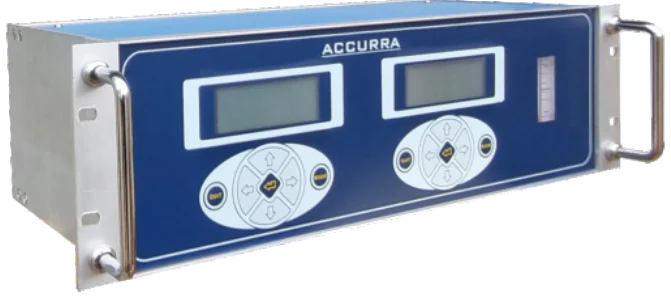
A filling station releases oxygen at a purity of at least 99.5 %. The analyser is an ACCURRA-S 3090 on 0 to 100 %. Take each source of error as a standard uncertainty in % O2:
| Source | Basis | Value, % O2 |
|---|---|---|
| Analyser | Datasheet intrinsic error +/- 0.1 % of full scale | 0.10 |
| Span gas | Certificate uncertainty, for example +/- 0.05 % absolute (read your certificate) | 0.05 |
| Drift between checks | Largest as-found deviation in the calibration history | 0.10 |
| Sample | Leak-tight, regulated, dry: small | 0.05 |
| Ambient pressure | Compensated: within the analyser figure | 0 |
combined = square root of (0.10 squared + 0.05 squared + 0.10 squared + 0.05 squared) = 0.16 % O2
So a reading of 99.5 % means the true purity is 99.5 +/- 0.16 %. To be confident the gas meets 99.5 %, release only at a reading of 99.66 % or more. That margin is called a guard band.
Remove compensation from the same budget. A 3 % fall in barometric pressure reads about 3 % low at 99.5 %, a three-percentage-point error. Every other line in the table disappears beside it. This is why purity analysers compensate: Why ambient pressure affects oxygen purity readings.
Rule of thumb
Aim for a combined error no more than a quarter to a third of the tolerance. Then a reading at the limit means the true value is very likely on the right side of it.
Guard bands and decision rules
When a measured value is compared with a limit, there are three choices. Release at the limit and accept that some off-spec product passes. Release only when the reading is inside the limit by the measurement uncertainty, and accept that some good product is held. Or reduce the uncertainty so the band is narrow enough not to matter.
The approach is set out in JCGM 106:2012, the international guide to the role of measurement uncertainty in conformity assessment, and the root-sum-of-squares combination comes from the Guide to the Expression of Uncertainty in Measurement (JCGM 100:2008). Both are free to read and worth citing in a quality procedure.
Decide the decision rule before you buy the analyser. It tells you how much a smaller uncertainty is worth in product that you no longer hold back.
When tighter accuracy buys nothing
- When the calibration gas is no better than the analyser: a better analyser cannot beat a poor reference.
- When the sample is the limit: a leak or condensation swamps a decimal place.
- When the process itself varies more than the error.
- When the reading only trends and nobody acts on its last digit.
A second example: burner trim
A gas-fired boiler is trimmed to 3 % oxygen in the flue. At 3 %, methane burns with about 15 % excess air; at 2.5 %, about 12.1 %. An oxygen error of +/- 0.2 % moves the excess-air estimate by roughly 1 percentage point, a fraction of a percent of fuel. Here repeatability and response matter more than the last decimal place of accuracy, and an in-situ zirconia probe with single-point air calibration is a sound choice: Combustion, excess air and flue gas oxygen explained.
Set beside the purity case, the lesson is that accuracy is priced by the decision, not by the instrument.
Use the range well
A span-based accuracy is best used with a range matched to the process: Accuracy, precision, repeatability and drift in gas analysers. A narrower range gives better absolute accuracy for the same percent of span. Tell the supplier the operating value so the range can be chosen: How to specify a gas analyser: A practical checklist.
- Start from the decision and its tolerance.
- Build an error budget from sensor, gas, drift, sample and environment.
- Combine independent errors by root-sum-of-squares.
- Aim for a quarter to a third of the tolerance; tighter often buys nothing.
Check your understanding
Answer in your head or on paper first, then open the answer. Recalling an answer teaches more than rereading.
A purity limit is 99.5 % minimum. What combined error might you aim for?
Perhaps 0.1 to 0.15 percentage points, a quarter to a third of the margin that matters to the release decision, depending on how close you run to the limit.
How do you combine independent errors?
By root-sum-of-squares.
Why can a better analyser fail to improve the result?
The calibration gas, sample or process variation may be the limiting error.
Key terms
Frequently asked questions
What accuracy do I need for oxygen trim?
Usually a few tenths of a percent of oxygen is adequate; control needs repeatability more than absolute accuracy.
Is plus or minus 1 % of span good enough?
It depends on the tolerance and where on the range the process runs.
How does calibration gas uncertainty affect accuracy?
It sets a floor: the reading cannot be known better than the reference.
Should I pay for the best accuracy?
Only if the decision needs it and the sample and calibration can support it.