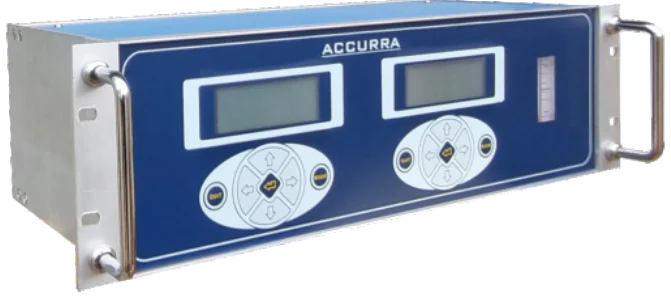
Auto-calibration switches zero and span gas to the analyser by solenoid valves on a timer, keypad or Modbus command, and adjusts or records the result. It is optional on most ACCURRA-S models; models 3015 and M015 have none. Use it to cut routine work and keep a drift record, but keep certified gas, check the results and decide whether the system adjusts or only validates.
- Describe how auto-calibration works
- Choose between validate-only and validate-and-adjust
- List what an auto-calibration setup needs
- Know its limits
How it works
Solenoid valves on the analyser inlet switch between sample, zero gas and span gas. A timer, the keypad or a Modbus command starts the sequence. The analyser waits for the reading to settle, records the deviation and, if configured, adjusts. It then returns to sample. During the sequence the output is held or flagged so the control system does not act on test gas: Connecting a gas analyser to PLC, DCS and SCADA.
Validate only or validate and adjust
- Validate only (a check): the analyser compares and records the deviation and alarms if it is out of tolerance, but does not change itself. A person decides what to do. This is the safer choice for safety and quality measurements.
- Validate and adjust: the analyser corrects itself within limits. It saves labour but can hide a developing fault, so keep limits on how large an automatic correction may be and alarm when the limit is reached.
Let the system adjust small drift automatically and alarm for a person on anything larger.
What you need
- An analyser with the auto-calibration option; it is optional on most ACCURRA-S models. Models 3015 and M015 are not available with auto-calibration, per the catalogue.
- A supply of certified zero and span gas with regulators and stainless tubing: Calibration gases: choosing, handling and certificates.
- A control-system plan for hold and release.
- A schedule: a typical start is a daily or weekly check, then adjust with experience.
Limits
- It cannot fix a leak, a blocked filter or a worn sensor; it may even mask them.
- It uses gas; plan cylinder size and change-out.
- Moisture cannot be calibrated from a cylinder, so it does not apply to dew point.
- It does not replace an occasional manual check against an independent reference.
Review the stored deviation history regularly: ACCURRA-S saves calibration with deviation values and alarm history.
- Auto-calibration switches zero and span gas by valves and records or adjusts.
- Validate-only is safer for critical measurements; limit automatic adjustments.
- It needs certified gas and a hold-and-release plan.
- Models 3015 and M015 have no auto-calibration; moisture needs a different approach.
Check your understanding
Answer in your head or on paper first, then open the answer. Recalling an answer teaches more than rereading.
What is the advantage of validate-only?
A person decides what to do with the deviation, so a fault cannot be hidden by automatic correction.
Which ACCURRA-S models lack auto-calibration?
3015 and M015, per the catalogue.
What should the control system do during an auto-calibration?
Hold or flag the value so it does not act on test gas.
Key terms
Frequently asked questions
Is auto-calibration available on all ACCURRA-S models?
It is optional on most; 3015 and M015 do not have it.
How often should auto-calibration run?
Daily or weekly is a common start; adjust to your drift records.
Does auto-calibration reduce the need for cylinders?
No, it needs certified gas connected to the analyser.
Can it start from the control system?
Via Modbus command on models that support it.