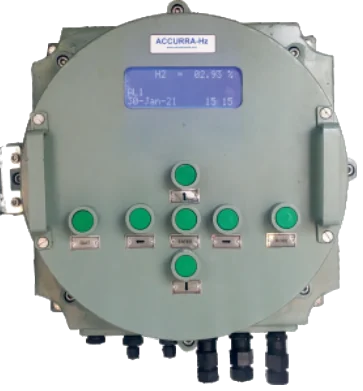
A safety integrity level (SIL 1 to 4) states how reliably a safety instrumented function does its job on demand. It belongs to the whole loop, sensor, logic solver and final element, not to a single device on its own. Hazardous-area certification is not SIL. Sarvesh makes no SIL claim for its analysers; if your project requires SIL-rated devices, tell us at the start.
- Define SIL and the safety instrumented function
- Distinguish SIL from hazardous-area certification
- Say why gas analysers are hard to use as SIL devices
- State what to ask a supplier
What SIL is
A safety instrumented function (SIF) detects a dangerous condition and acts to bring the process to a safe state: for example, oxygen rising in a vessel closes a valve. Standards IEC 61508 and IEC 61511 define four levels of integrity. For functions used rarely (low demand), the levels correspond to the average probability of failure on demand:
| SIL | Average probability of failure on demand (low demand) |
|---|---|
| SIL 1 | 10^-2 to below 10^-1 |
| SIL 2 | 10^-3 to below 10^-2 |
| SIL 3 | 10^-4 to below 10^-3 |
| SIL 4 | 10^-5 to below 10^-4 |
Higher SIL means a lower probability of the function failing when needed.
SIL is a loop property
The probability is for the whole function: sensor, logic solver, final element such as a valve, and the interconnections. A SIL 2 function can be built from components of lower claimed integrity with redundancy, and a high-integrity device can be ruined by a poor installation. A device can be assessed for use in such a loop, with failure-rate data and a safety manual.
It is not the same as hazardous-area certification
A flameproof or intrinsically safe certificate says the equipment will not ignite a flammable atmosphere. It says nothing about whether the reading is right or whether a failure is detected. Do not read Group IIC, Zone 1 and T6 as a SIL: Protection concepts: flameproof, intrinsic safety, purging.
Why analysers are difficult
- A sample-based measurement can fail silently: a blocked line or an aged sensor gives a plausible reading.
- Calibration drift needs regular proof tests with test gas.
- The sample system is part of the function and must be assessed too.
- Response time must meet the process safety time, and must be stated.
In practice, safety functions on gas measurement often use redundancy and independent diversity, with proof testing, and are designed by the safety engineer for the specific case.
What we say
Sarvesh makes no SIL claim for its analysers, so a project should not assume one. If your design requires SIL-rated measurement, tell us at the outset and we will state, point by point, what we can and cannot support.
Questions to ask any supplier: is there a safety manual, failure-rate data, a stated response time and a proof-test procedure? See Questions to ask a gas analyser supplier before you buy.
- SIL belongs to a safety function, not to a device alone.
- Hazardous-area certification is not SIL.
- Gas analysers are difficult SIL devices because of silent failures, drift and the sample system.
- Sarvesh makes no SIL claim; tell us your requirement early.
Check your understanding
Answer in your head or on paper first, then open the answer. Recalling an answer teaches more than rereading.
What does SIL 2 describe?
A safety function with a probability of failure on demand between 10^-3 and 10^-2 for low-demand use.
Does Group IIC, Zone 1 T6 certification make an analyser SIL rated?
No. It addresses ignition risk, not the reliability of the safety function.
Why is proof testing needed for an analyser in a safety function?
Failures such as drift or a blocked sample can be silent, so periodic tests with test gas are needed to reveal them.
Key terms
Frequently asked questions
Are ACCURRA analysers SIL rated?
We make no SIL claim. Tell us your requirement and we will respond point by point.
What is the difference between SIL and Ex certification?
Ex certification addresses ignition of explosive atmospheres; SIL addresses the reliability of a safety function.
Can a gas analyser be part of a safety loop?
Yes, with a proper safety design, but it needs careful treatment of sample, drift and response time.
What is proof testing?
A periodic test that reveals hidden failures in a safety function.