
A hazardous area analyser is built so it cannot ignite flammable gas. Certification states the zone, the gas group and the temperature class. ACCURRA-Hz uses a flameproof enclosure certified for Gas Group IIC, Zone 1 and 2, T6, which covers hydrogen and is the most demanding group.
- Read a certification that names zone, gas group and temperature class
- Explain what Gas Group IIC and T6 mean
- Describe what a flameproof enclosure does
Zones
Zones describe how likely a flammable atmosphere is. Zone 0 is where it is present continuously or for long periods. Zone 1 is where it is likely to occur occasionally in normal operation. Zone 2 is where it is not likely in normal operation and, if it occurs, lasts only a short time. Dust areas use separate zone numbers. The plant's area classification drawings assign zones.
Gas groups
Gas groups rank gases by how easily they ignite and how strongly they pass through narrow gaps. Group IIA includes propane, IIB includes ethylene, and IIC is the most demanding, including hydrogen and acetylene. Equipment certified for IIC can be used in IIA and IIB areas.
Gas groups, in numbers
Gas groups are set by how readily a gas ignites and how easily a flame passes through a narrow gap. The gap is called the maximum experimental safe gap (MESG), per IEC 60079-20-1:
| Group | MESG | Example gases |
|---|---|---|
| IIA | above 0.9 mm | Propane, methane in industry, many solvents |
| IIB | 0.5 to 0.9 mm | Ethylene |
| IIC | below 0.5 mm | Hydrogen (about 0.29 mm), acetylene |
A flameproof enclosure keeps every joint gap below the value that stops a flame for its group. That is why IIC equipment is heavier and why it covers IIA and IIB too.
Temperature classes
The T-class is the maximum surface temperature the equipment can reach, which must stay below the ignition temperature of the gas. T1 is 450 C, T2 300 C, T3 200 C, T4 135 C, T5 100 C and T6 85 C. T6 is the most restrictive and so the most widely applicable.
Worked example: a hydrogen electrolyser room
- Zone. The plant's IEC 60079-10-1 study classifies the room around the stack and separators as Zone 2.
- Gas group. Hydrogen: IIC.
- Temperature class. Hydrogen's auto-ignition temperature is about 560 C, so T1 would already do. A T6 rating (85 C) covers it with margin and covers other gases in the area.
- Check the analyser. ACCURRA-Hz is certified for Gas Group IIC, Zone 1 and 2, T6 to IS/IEC 60079-1:2014. It meets all three. INFINITY-Tx, a 24 V DC two-wire transmitter for percent oxygen or trace CO, carries the same IIC, Zone 1 and 2, T6 rating.
Checking only the zone. A Zone 1, IIB, T3 instrument is not suitable in a hydrogen area, whatever its zone.
Flameproof enclosures
A flameproof enclosure, marked Ex d and covered by IEC 60079-1, contains an internal explosion and cools escaping gases so they cannot ignite the outside atmosphere. The enclosure is heavy and its covers must not be opened casually when gas may be present, which is why calibration without opening the cover is valuable.
Reading the marking
A modern marking packs the answer into one line, for example Ex db IIC T6 Gb. Ex: explosion protected. db: flameproof enclosure (d), at protection level b. IIC: gas group. T6: maximum surface temperature 85 C. Gb: equipment protection level b, suitable for Zone 1 and Zone 2. IEC 60079-0 sets the general rules and the EPL system: Ga for Zone 0, Gb for Zone 1, Gc for Zone 2.
Other protection concepts are intrinsic safety (Ex i, IEC 60079-11) and pressurisation (Ex p, IEC 60079-2): Protection concepts: flameproof, intrinsic safety, purging.
ACCURRA-Hz and INFINITY-Tx
ACCURRA-Hz uses an enclosure certified for Gas Group IIC, Zone 1 and 2, T6, as per IS/IEC 60079-1:2014, and can be calibrated without opening the covers. INFINITY-Tx is a loop-powered two-wire transmitter for the field. Please ask us for current certificate copies and confirm the scope against your area classification. We make no SIL claim for these products.
Installation, inspection and approvals
- Install to IEC 60079-14: certified cable glands, correct cable, earthing and sealing for the protection concept.
- Inspect to IEC 60079-17: periodic checks of enclosure joints, glands and bolts. A cover that has been opened and refitted carelessly is no longer flameproof.
- Calibrate without opening covers. ACCURRA-Hz is calibrated tamper-proof with the covers closed, which avoids a hot-work permit and a gas-free certificate for routine work.
- Approvals. Certification schemes and local rules differ: IECEx, ATEX in Europe, and in India the approvals required under the Petroleum and Explosives Safety Organisation for many installations. Confirm with your site which approval is required and ask us for the current certificate and its scope before ordering.
- Safety functions. A certificate says the equipment will not ignite gas. It says nothing about the reliability of the reading. We make no SIL claim: What SIL means for gas analysers, and what it does not.
- Certification states zone, gas group and temperature class.
- Group IIC is the most demanding gas group and covers hydrogen.
- T6 limits surface temperature to 85 C.
- A flameproof enclosure contains an internal explosion and cools the escaping gas.
Check your understanding
Answer in your head or on paper first, then open the answer. Recalling an answer teaches more than rereading.
What three things does a hazardous-area certificate state?
The zone it is suitable for, the gas group, and the temperature class.
Why does hydrogen need Group IIC equipment?
Hydrogen ignites with very little energy and has a narrow safe gap, so only equipment certified for the most demanding group is suitable.
Does a certified enclosure make a measurement a safety function?
No. Certification says the equipment will not ignite gas. It says nothing about SIL or the reliability of the reading as a safety function.
Key terms
Frequently asked questions
What does Gas Group IIC mean?
The most demanding gas group, which includes hydrogen and acetylene. IIC-certified equipment also suits IIA and IIB gases.
What does T6 mean?
A maximum surface temperature of 85 C.
What is a flameproof enclosure?
An Ex d enclosure that withstands an internal explosion and prevents it igniting the outside atmosphere.
Is ACCURRA-Hz SIL rated?
We make no SIL claim. If your project requires SIL-rated devices, tell us at the start.
Related products
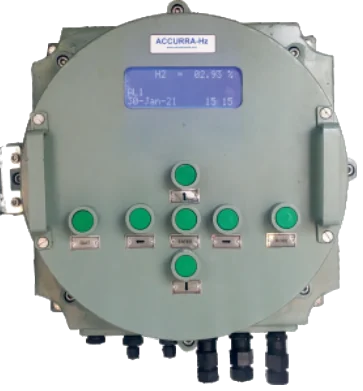
ACCURRA-Hz
Process gas analyser in an enclosure certified for Gas Group IIC, Zone 1 and 2, T6.
View ACCURRA-Hz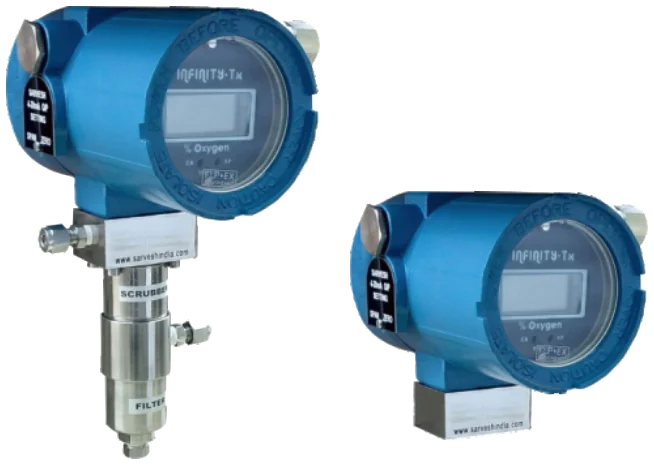
INFINITY-Tx
Loop-powered two-wire transmitter for percent O2 and trace CO in hazardous areas.
View INFINITY-Tx