
The limiting oxygen concentration (LOC) is the oxygen level below which a flammable vapour or dust cannot sustain a flame. Inerting keeps oxygen below it with a margin. An oxygen analyser on the headspace confirms the margin and triggers purging or interlocks if oxygen rises.
- Define limiting oxygen concentration
- Explain how inerting uses it with a safety margin
- Decide where an oxygen analyser should sample
What LOC is
A flame needs fuel, oxygen and ignition. For each fuel and inert gas combination there is a minimum oxygen concentration below which flame propagation is not possible even with fuel in the flammable range. That value is the limiting oxygen concentration. For many organic vapours in nitrogen it lies roughly between 8 and 12 % oxygen, and for hydrogen in nitrogen it is much lower, near 5 %. Values depend on the fuel, the inert gas, temperature and pressure.
Inerting, blanketing and purging
Inerting replaces air in a vessel with nitrogen or another inert gas. Blanketing holds a small positive pressure of inert gas above the liquid so that air cannot enter as the tank breathes. Purging flushes a vessel before and after use. All three work by keeping oxygen below the LOC.
Safety margin
Plants keep oxygen below the LOC with a margin. Commonly cited guidance, such as NFPA 69, uses a margin below the lowest credible LOC, and a larger relative margin where the LOC is low and where oxygen is not monitored continuously. Your own hazard study sets the alarm and trip points; the analyser's alarm set points are configurable to match them.
The analyser's job
An oxygen analyser on the headspace, the vent or the nitrogen supply measures the barrier. A relay output can raise an alarm, start a purge, stop charging or trip a heater. For ppm-level blanketing, ACCURRA-S 3015 reads 0 to 1000 ppm. For percent-level inerting, model 3030 reads 0 to 25 % and model 3130 reads 0 to 100 %. In hazardous areas, ACCURRA-Hz and INFINITY-Tx cover the requirement.
Where to sample
Sample from the headspace or the vent, not from a dead leg where gas stagnates. Protect the analyser from solvent vapour carry-over with a filter, and size the sample flow for the response time you need.
- Below the LOC a flame cannot sustain itself.
- Inerting keeps oxygen below the LOC with a margin.
- A continuous oxygen reading proves the margin and triggers purge or interlock.
- LOC depends on the fuel and the inert gas.
Check your understanding
Answer in your head or on paper first, then open the answer. Recalling an answer teaches more than rereading.
What does a limiting oxygen concentration tell you?
The oxygen level below which a particular flammable vapour or dust cannot sustain combustion.
Why keep oxygen well below the LOC rather than just under it?
Measurement error, mixing and upsets mean the true oxygen can be higher than the reading, so a margin keeps the headspace safe.
Where should the sample be taken from a blanketed tank?
From the headspace, at a point representative of the gas above the liquid and away from the nitrogen inlet.
Key terms
Frequently asked questions
What is a typical LOC?
For many organic vapours in nitrogen, roughly 8 to 12 % oxygen; for hydrogen in nitrogen, near 5 %. Use values for your own materials.
What oxygen alarm should I set?
The value comes from your hazard study, as a margin below the LOC. The analyser alarm points are configurable.
Which analyser for a blanketed tank?
ACCURRA-S 3015 for ppm, 3030 or 3130 for percent, and ACCURRA-Hz or INFINITY-Tx in hazardous areas.
Does nitrogen blanketing need continuous monitoring?
Continuous monitoring is the usual way to demonstrate the barrier holds, and it permits a smaller margin under common guidance.
Related products
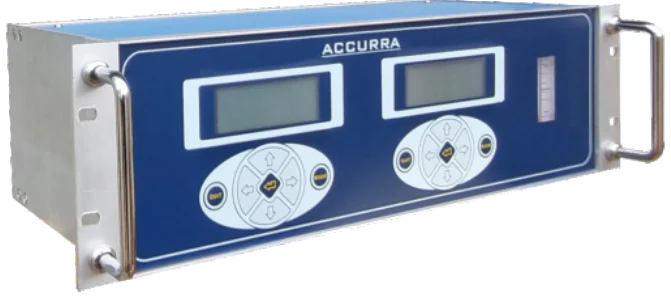
ACCURRA-S
Online analyser for trace, percent and purity O2, CO, CO2, CH4 and dew point; can measure two gases from one sample.
View ACCURRA-S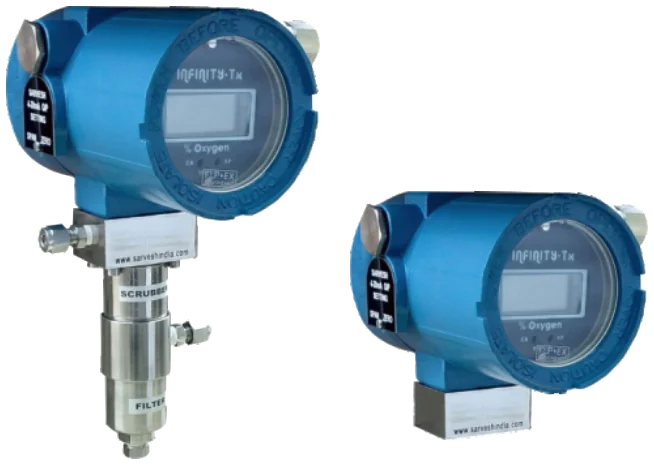
INFINITY-Tx
Loop-powered two-wire transmitter for percent O2 and trace CO in hazardous areas.
View INFINITY-Tx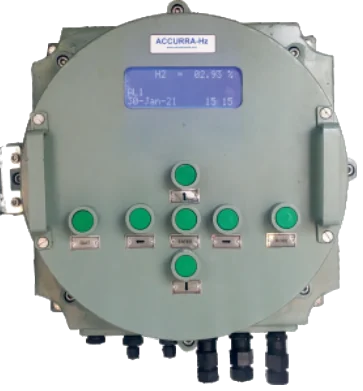
ACCURRA-Hz
Process gas analyser in an enclosure certified for Gas Group IIC, Zone 1 and 2, T6.
View ACCURRA-HzWhere this applies
- Nitrogen blanketing and inerting
- Closed-loop dryers and spray dryers
- Reactors, hydrogenation and polymerisation
- Hazardous-area oxygen analyser
- INFINITY-Tx