
ACCURRA-Zr measures oxygen in fired heater and reformer furnace flue gas in situ, 0.1 to 21 %, calibrated on air at a single point, with auto blowback and high-dust and 1400 °C probe options, so the burners can run at the lowest safe excess air.
The measurement and why it matters
Excess air is the largest loss a heater operator controls. Too little air and the fuel does not burn completely, CO rises and the heater can become unsafe; too much and the extra air leaves the stack hot. Flue gas oxygen is how the balance is held, either by the operator or by an automatic trim on the air dampers.
ACCURRA-Zr measures oxygen from 0.1 to 21 % in situ. Its sensor sits just outside the duct, fed through a guide tube, so there is no sample line to block and the sensor stays clear of dust and temperature swings. It is calibrated on plain air at a single point and cleans its probe by automatic blowback. High-dust and 1400 °C probe options cover hotter and dirtier locations.
Steam reformers in ammonia, methanol and hydrogen plants are large multi-burner furnaces with the same need. Their flue gas is clean, so the question is where to measure: high enough in the radiant section or at the convection inlet to represent combustion, and at a temperature the probe option is rated for.
Air leaking into the convection section raises the oxygen reading above what the burners see. Measure as close to the radiant section as the probe allows, and where a second reading at the stack is used, read the difference as a measure of air ingress.
Models and ranges
| Model | Measures | Range | Sensor and notes |
|---|---|---|---|
| ACCURRA-Zr | Flue gas oxygen, in situ | 0.1 to 21 % O2 | Zirconia, air calibration, auto blowback |
| ACCURRA-Zr probe options | Hot or dusty locations | High-dust; up to 1400 °C | Choose by location |
| 2015 | CO in flue gas, extractive | 0 to 1000 ppm (min range 0 to 100 ppm) | ACCURRA-S, electrochemical cell |
Process notes
Trim on oxygen, check on CO
An oxygen trim sets the air; a CO reading shows when the oxygen set point has gone too low for complete combustion. Where both are wanted, ACCURRA-Zr reads oxygen in situ and an extractive ACCURRA-S 2015 reads ppm CO from a sample drawn and conditioned for it.
Hazardous areas around heaters
Heater surroundings are often classified. Tell us the area classification at the probe location and the analyser location with the enquiry.
Sampling and installation
- ACCURRA-Zr measures in situ and needs no sample line; provide instrument air for blowback and a mounting flange at the chosen location.
- Choose the probe option for the flue gas temperature and dust at the location.
- For extractive CO, draw the sample through a probe and conditioner sized for the flue gas, and vent it safely.
ACCURRA-S sample specification: non-corrosive, non-toxic, non-flammable, non-condensing and dry, free from entrained oil; sample pressure 2 to 10 psig, regulated externally; flow about 1 LPM; dust below 3 micron. Where your sample differs, we design conditioning around it.
Send us your process data
The same pre-order design inputs our engineers design from, online. Fill in what you know, leave the rest. Your draft saves as you go, and you can print or send it when ready.
What matters most for this application
- The heater or furnace type and the fuel
- Flue gas temperature and dust at the proposed probe location
- Duct or stack dimensions and the mounting flange
- The area classification at the probe
Recommended Sarvesh products
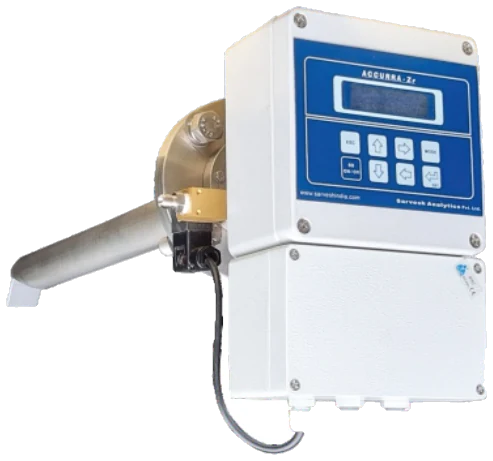
ACCURRA-Zr
In-situ zirconia oxygen with air calibration and auto blowback.
View ACCURRA-Zr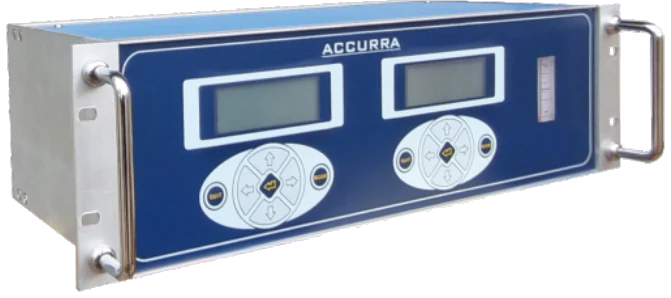
ACCURRA-S
Extractive ppm CO for combustion checks.
View ACCURRA-S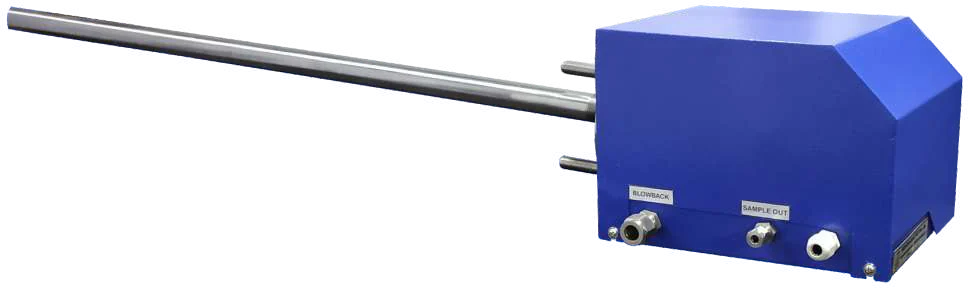
SP and SRP sample probes
Sample probes for extractive measurement.
View SP and SRP sample probesAsk for a price
Leave your details and an applications engineer in Pune, India, replies with questions or a proposal.
Frequently asked questions
Does the zirconia analyser need a sample system?
No. It measures in situ, with the sensor just outside the duct.
How is it calibrated?
On plain air at a single point.
Can it go into a reformer furnace?
Yes, at a location within the temperature rating of the probe option, up to 1400 °C.
Why measure CO as well as oxygen?
CO shows when the oxygen set point is too low for complete combustion.