
Burners need slightly more air than the exact amount that burns the fuel, so that combustion is complete. The extra, called excess air, carries heat up the stack and wastes fuel, while too little air leaves carbon monoxide and soot. Flue gas oxygen measures the excess; CO shows when air is too short. Trimming air to just above the point where CO starts to rise saves fuel.
- Explain stoichiometric and excess air
- Describe why oxygen and CO are read together
- Relate flue gas oxygen to excess air numerically
- Explain where an in-situ oxygen analyser sits
What combustion needs
Burning a fuel combines its carbon and hydrogen with oxygen from air to make CO2 and water. The exact air for complete combustion is the stoichiometric air. Real burners cannot mix fuel and air perfectly, so they supply more air than that to make sure all the fuel finds oxygen. That extra is excess air.
The trade-off
- Too much excess air: the extra air is heated to stack temperature and wasted, lowering efficiency. It also cools the flame.
- Too little air: fuel is not burnt fully. Carbon monoxide, soot and unburnt fuel appear. This wastes fuel, pollutes and can be dangerous.
The best setting sits just above the point where CO starts to rise. Plants therefore read both oxygen and CO: Measuring carbon monoxide and carbon dioxide online.
Oxygen tells you the excess air
Because air is about 21 % oxygen, any oxygen left in the dry flue gas came from unused air. The relation is simple: excess air in percent is O2 divided by (20.95 minus O2), times 100. At 3 % oxygen that is about 17 % excess air; at 5 % it is about 31 %.
Try the calculatorExcess air from flue gas oxygen calculatorComparing wet and dry oxygen readings without noticing. In-situ analysers read wet, extractive dry, and the numbers differ: Dry basis vs wet basis in gas measurement.
Where the analyser sits
Oxygen is usually measured in the flue gas, after the furnace or boiler and before the stack, at a point upstream of air leaks. ACCURRA-Zr mounts on the duct with no sample line, its zirconia cell protected just outside the wall, with options for high dust and temperatures up to 1400 C: How a zirconia oxygen analyser works. If you need CO and other gases, an extractive system takes a conditioned sample.
Air in-leakage
Duct leaks after the furnace add air that did not take part in combustion. The analyser then shows more oxygen than the burner is using, and the trim control runs the burner lean to compensate. Measure upstream of leaks and keep the ductwork tight.
What oxygen trim achieves
- Burner air is adjusted automatically from the oxygen reading, with CO as a safety limit.
- Fuel use falls because excess air is held near the optimum across load changes and fuel quality changes.
- Emissions often improve too, though the trim target must respect CO and NOx limits.
For emission reporting, concentrations are corrected to a reference oxygen: Emission correction to reference oxygen. Typical oxygen targets differ by fuel and burner; take them from the burner supplier and your commissioning tests.
- Stoichiometric air burns the fuel exactly; real burners use some excess air.
- Excess air wastes heat; too little air leaves CO and soot.
- Excess air % = O2 / (20.95 - O2) x 100, on a dry basis.
- Read oxygen and CO together, upstream of air leaks.
Check your understanding
Answer in your head or on paper first, then open the answer. Recalling an answer teaches more than rereading.
What is excess air?
Air supplied beyond the exact amount needed to burn the fuel completely.
What does a rising CO reading with falling oxygen indicate?
The burner is running short of air, near or past the CO breakpoint.
What excess air does 3 % dry oxygen indicate?
About 17 %.
Key terms
Frequently asked questions
What oxygen level should a boiler run at?
It depends on fuel and burner; take the target from the burner supplier and your commissioning, and trim to just above the CO breakpoint.
Why is oxygen measured in flue gas?
It is the simplest indicator of excess air and therefore of fuel efficiency.
Why measure CO too?
To make sure that reducing excess air does not cause incomplete combustion.
Which Sarvesh product measures flue gas oxygen?
ACCURRA-Zr, an in-situ zirconia analyser.
Related products
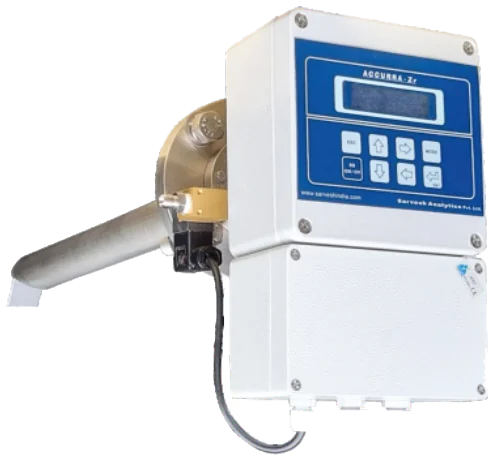
ACCURRA-Zr
Zirconia percent O2 analyser for furnaces and boilers, single-point air calibration, options to 1400 C.
View ACCURRA-Zr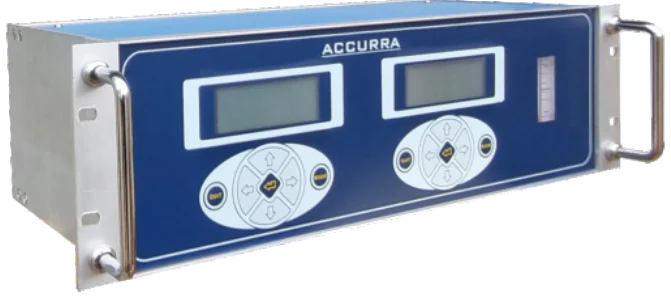
ACCURRA-S
Online analyser for trace, percent and purity O2, CO, CO2, CH4 and dew point; can measure two gases from one sample.
View ACCURRA-S