
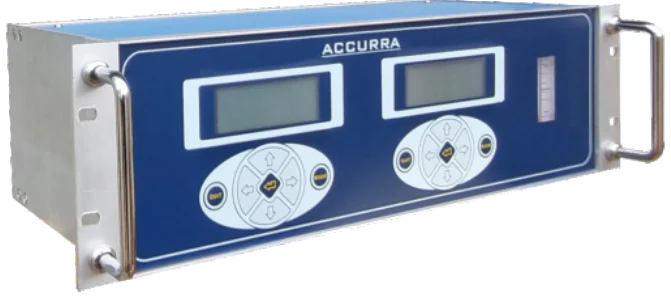
Many oxygen sensors respond to the partial pressure of oxygen, which falls when barometric pressure falls even if the gas is unchanged. A 5 % pressure drop reads about 5 % low. ACCURRA-S 3090 and 3190 correct for ambient pressure and temperature, reducing the error to below 0.5 %.
- Explain why a partial-pressure sensor changes its reading with barometric pressure
- Estimate the size of the error for a given pressure change
- State what to ask a supplier about pressure compensation
Partial pressure is what many sensors see
Dalton's law says the partial pressure of a gas in a mixture equals its fraction multiplied by the total pressure. If barometric pressure falls by 5 %, the partial pressure of oxygen in a pure oxygen sample falls by 5 % too, although the gas is exactly as pure as before. A sensor that responds to partial pressure reports a lower number.
How big is the error?
The ACCURRA-S catalogue notes that a day and night ambient pressure variation can cause an error of up to 10 % in the oxygen reading above about 90 %. Take a 3 % fall in pressure, which is an ordinary weather change: an uncompensated analyser calibrated at 1013 mbar and reading 100 % oxygen would show about 97 %. Against a 99.5 % target, that error can reject a good batch or, with the pressure swinging the other way, pass a bad one.
Worked examples
Weather. An uncompensated analyser is calibrated at 1008 hPa on a fine morning. A monsoon low brings the barometer down to 996 hPa. A true 99.6 % oxygen stream now reads 99.6 x 996 / 1008 = 98.4 %. A good batch fails a 99.5 % release.
A storm. At 990 hPa against a calibration at 1013 hPa, 99.5 % reads 99.5 x 990 / 1013 = 97.2 %.
The vent. The analyser vents into a header that runs 20 mbar above atmosphere when the plant is busy. The sensor sees about 2 % more pressure and a true 99.5 % reads about 101 %. The weather is not the only pressure that moves.
Altitude matters only through calibration. Pune sits at about 560 m, where the standard atmosphere gives about 948 hPa. An analyser calibrated on site at that pressure reads correctly there; one calibrated at sea level and installed without recalibration reads about 6.5 % low.
Temperature matters too
Temperature changes gas density and the behaviour of sensor components. In a paramagnetic cell, the susceptibility of oxygen falls with absolute temperature, so the cell must be temperature controlled or corrected. In an electrochemical or ceramic cell, temperature changes response and diffusion. All ACCURRA-S measurements have built-in temperature compensation.
Temperature, in numbers
For a paramagnetic cell, the signal follows Curie's law: it falls in inverse proportion to absolute temperature. A 10 degree rise from 20 C to 30 C reduces it by 3.3 %, as large as a typical weather change in pressure. ACCURRA-S applies temperature compensation on all measurements; the purity models 3090 and 3190 also measure ambient pressure, and the datasheet gives a combined error below 0.5 %.
How compensation works
ACCURRA-S 3090 and 3190 contain an ambient pressure sensor and a temperature sensor. The microcontroller applies a correction to the raw oxygen signal in real time, so the displayed reading refers to standard conditions. With compensation, the catalogue gives an error below 0.5 %.
Where the pressure goes after the sensor
Compensation corrects for the pressure at the sensor, which is ambient pressure only if the vent is free. Keep the analyser outlet short and open to atmosphere, or to a vent that does not see back-pressure. If a common vent header is unavoidable, measure the pressure there and ask whether the analyser's sensor sees it.
- Regulate the inlet to the 2 to 10 psig range ACCURRA-S expects, so flow is steady.
- Do not throttle the outlet to set flow: that raises the pressure in the cell.
- Calibrate with the span gas flowing at the same rate and vented the same way as the sample.
- Record the barometric pressure with each calibration check, so a later reviewer can see it.
What to ask when you specify a purity analyser
- Does the analyser compensate for ambient pressure, and with its own sensor?
- What is the stated error with compensation, and over what range?
- Does the sample need to be regulated, and to what pressure?
- Is calibration history stored, so an auditor can see drift?
Why it matters most near 100 %
A pressure error is a percentage of the reading, not of the scale. At 1 % oxygen, a 3 % pressure change is 0.03 % oxygen and rarely matters. At 99.5 %, the same change is three percentage points, larger than the whole gap between good and rejected product. That is why the ACCURRA-S datasheet warns of an error of up to 10 % above about 90 % without compensation, and why the effect appears in purity work and almost nowhere else.
For the full error budget of a purity release, see What accuracy do you really need from a gas analyser.
- Many oxygen sensors respond to partial pressure, not percentage.
- A 5 % fall in absolute pressure reads about 5 % low.
- Compensation corrects for ambient pressure and temperature; it does not replace calibration.
- The effect matters most near the top of the scale, where purity limits are tight.
Check your understanding
Answer in your head or on paper first, then open the answer. Recalling an answer teaches more than rereading.
The air pressure at the sensor drops from 1013 hPa to 990 hPa. A true 99.5 % oxygen stream reads roughly what on an uncompensated sensor?
About 97.2 %. The reading scales with absolute pressure: 99.5 x 990 / 1013 = 97.2. Use the pressure effect calculator to check.
Does pressure compensation make calibration unnecessary?
No. Compensation removes the weather and temperature effect. Calibration still corrects sensor ageing and offset.
Why is the effect most damaging on a purity analyser?
Purity limits are tight, such as 99.5 % minimum, so a one or two percent shift can turn a good batch into an apparent failure.
Key terms
Frequently asked questions
Why does barometric pressure affect oxygen analysers?
Many sensors respond to oxygen partial pressure, which scales with total pressure. A fall in pressure lowers the reading even though the gas is unchanged.
How much error can pressure cause?
The ACCURRA-S catalogue states up to 10 % over a day and night swing in the 90 to 100 % range, without compensation.
Which ACCURRA-S models compensate?
Purity models 3090 (electrochemical, 0 to 100 %) and 3190 (paramagnetic, 95 to 100 %).
Does compensation remove the need for calibration?
No. Calibration is still needed, but compensation keeps the calibration valid across weather and seasons.
Related products
Where this applies
- Oxygen purity in air separation plants
- Medical oxygen plant purity monitoring
- ACCURRA-S oxygen analysers