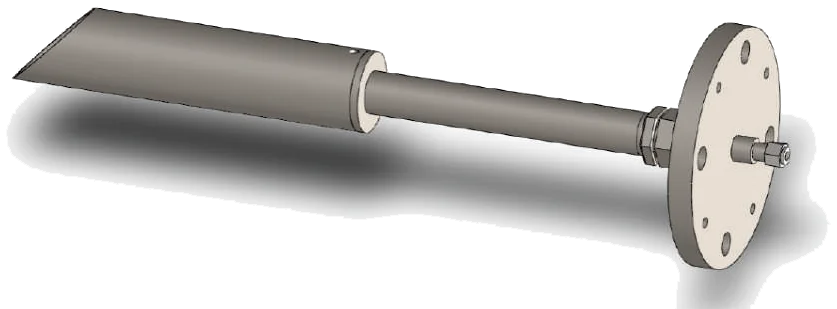
Take the sample where the gas is well mixed, at process conditions you understand, upstream of any air leak, away from dead zones, and with a tapping that cannot fill with liquid or dust. In a duct, a single wall tapping may miss stratified flow, so a probe that reaches into the stream or a traverse is used. A good analyser on a bad tapping gives a precise wrong answer.
- List the criteria for a representative sample point
- Recognise stratification and dead zones
- Choose tapping orientation and probe type for gas, dusty gas and wet gas
- Avoid placing a tapping downstream of air leaks
What representative means
A sample is representative when its composition equals that of the gas you care about, at the moment you care about. Three things spoil that: the gas is not uniform where you tap, the tapping gives access to a stagnant pocket, or the sample changes between the tapping and the analyser.
Rules for a good tapping
- Well mixed. After a bend, a mixer or enough straight run for gases to blend. Right after a gas injection point, the gas is not mixed.
- Before any leak. Air leaks into negative-pressure ducts. Tap upstream of damper seals, expansion joints and inspection doors or you measure the leak.
- Away from dead zones. Stagnant corners and dead legs hold old gas and respond late.
- Process conditions known. Pressure, temperature and dew point at the tapping tell you what sample system is needed.
- Accessible and safe. Technicians must reach it and isolate it.
Stratification in ducts
In a large duct, flue gas can flow in layers with different oxygen and temperature. A tapping on the wall sees one layer. Probes that reach into the duct, several tappings, or a traverse, give a better average. In-situ probes such as ACCURRA-Zr measure along a path into the gas: Extractive vs In-Situ gas analysis.
Placing a single tapping beside an economiser bypass or damper and trusting the result as the plant average.
Worked examples: straight runs and leaks
Straight run in a stack. EN 15259 asks for a measurement plane in a straight section, with typically at least five hydraulic diameters of straight duct upstream and two downstream (five if the plane is near the stack exit). For a 3 m x 2 m rectangular duct the hydraulic diameter is 4 x area / perimeter = 4 x 6 / 10 = 2.4 m: about 12 m upstream and 4.8 m downstream.
A leak upstream of the tap. Flue gas at 3.0 % oxygen picks up 5 % air through a loose inspection door. The mixture is 0.95 x 3.0 + 0.05 x 20.95 = 3.9 % oxygen. The burner trim sees too much air and cuts it, and the fire runs rich. At 10 % air the reading is 4.8 %.
Checking for stratification. Traverse the duct with a portable analyser at several depths and widths. If oxygen varies by more than a few tenths of a percent across the plane, a single point is not representative.
Orientation and the tapping itself
- Gas lines: tap from the top of a horizontal pipe so liquid does not run into the sample.
- Wet gas: a drain and a downward slope let condensate leave. See Condensate, moisture and sample cooling for gas analysis.
- Dusty gas: a probe with a filter and a way to clear it, usually blowback: Probes and blowback for hot, dusty and tarry gas.
- Pressurised gas: an isolation valve and a pressure reducer close to the tapping keep the line volume small.
Keep the tapping as small as is practical. A large tapping volume adds lag and holds old gas.
Pipes carrying process gas
- Probe tip position. In a pipe, a probe that reaches into the middle third of the bore samples the main stream rather than the wall layer, where liquids and old gas collect. ISO 10715 gives this guidance for natural gas.
- Pressure letdown at the tap. Reduce pressure right at the tapping. A 10 m line at 6 bar(g) holds seven times as much gas as the same line at atmosphere, and takes seven times as long to flush: Sample lines: materials, length, diameter and lag.
- Liquid draws. A sample from liquid must be vaporised completely and quickly at the tap: Sampling cryogenic and liquefied gases: vaporisers.
- After mixing points. Downstream of a gas injection, allow enough run or a static mixer before the tap; a reading just after injection measures the injection, not the blend.
Document it
Record the tapping location, orientation and the process conditions there. Many later troubleshooting questions are answered by whether the tapping is what the drawing says: Sample system troubleshooting: symptoms to causes.
A checklist for the site walk
- Is the gas well mixed at this point, and could layers form?
- Is the tap upstream of every place where air can leak in?
- Is the duct or pipe under suction here? If so, every joint upstream of the tap matters.
- Will liquid or dust run into the tap? Is it on top or on the side?
- Is the process pressure, temperature and dew point at the tap known?
- Can a technician reach it, isolate it and clean it safely?
- How far is the analyser, and what is the line lag at the planned flow?
- Is there a spare port for a check probe or calibration gas?
Send the answers with the application data sheet: The application data sheet: what to send Sarvesh.
- Tap where the gas is mixed, upstream of leaks and away from dead zones.
- A wall tapping can miss stratified duct flow; use a probe or traverse.
- Tap from the top of horizontal gas lines; give wet gas a drain.
- Keep the tapping volume small and document it.
Check your understanding
Answer in your head or on paper first, then open the answer. Recalling an answer teaches more than rereading.
Why tap upstream of damper seals in a negative-pressure duct?
Air leaks in at the seals, so a tapping downstream measures air, not the process.
Why take a gas sample from the top of a horizontal pipe?
So liquid does not run into the sample line.
A duct oxygen reading differs from a second tapping a metre away. What is likely?
Stratification: the gas is not uniform across the duct.
Key terms
Frequently asked questions
Where should a sample point be?
At a well-mixed location, upstream of air leaks, at known process conditions and accessible for maintenance.
How far downstream of a gas injection point should I sample?
Far enough for mixing, typically several pipe diameters of turbulent flow or a mixing element. Ask for advice for your case.
Does the tapping affect response time?
Yes. A large or dead tapping volume adds lag.
Can you advise on the sample point?
Yes. Send a drawing or photographs with the application data sheet.