
A good sample handling system delivers a representative, clean, dry sample at constant pressure and flow. Keep the sample above its dew point until the cooler, keep lines short, filter in stages, and supervise faults. ACCURRA-S expects a dry, non-corrosive, non-flammable sample at 2 to 10 psig and about 1 LPM.
- List the stages of a sample handling system in order
- Apply the rules that keep a sample representative
- State what an ACCURRA-S expects at its inlet
The chain
A typical extractive chain has a probe with a filter at the tip, a transport line, a cooler or vaporiser to condition the sample, a pump, fine filters and scrubbers, and then the analyser. Each stage has a job and a failure mode.
Typical failure modes
- A blocked probe filter reduces flow and the analyser reads stale gas
- Condensate in the line absorbs soluble gases and floods the analyser
- A leak lets air in; at ppm level it dominates the reading
- A failed pump gives no flow, with no obvious sign
- Dead volumes and long lines slow the response
Supervision: let the system say when it is wrong
A sample system fails quietly. The analyser keeps reading, but what it reads is no longer the process. Supervision turns each failure into an alarm:
| Failure | What detects it | What should happen |
|---|---|---|
| Cooler warm | Cooler temperature | Pump stops; SGI-300 runs the external pump only when the sample is below 12 C and dry |
| Water past the cooler | Condensate sensor | Pump stops, alarm, so the analyser is not flooded |
| Probe filter blocking | Flow falls | Blowback, then alarm if flow does not recover |
| Heated line cold | Pt100 on the hose | Alarm; readings flagged |
| Calibration running | Digital inputs from the analyser | Outputs frozen, control system told |
i-Cons reads these inputs and reports values, status and maintenance history over Modbus, so the control room sees the sample system's health, not just a number.
Design rules
- Keep the sample above its dew point, with a heated probe and line, until the cooler
- Condition in one place: cool, drain and filter before the analyser
- Keep lines short and small in volume, in stainless or PTFE as the gas requires
- Filter in stages: probe filter, then coalescing or fine filter
- Provide blowback for dusty gas, and make it automatic on flow failure
- Measure flow and condensate, and trip the pump on a fault
- Calibrate through the same path where possible
A worked design: boiler flue gas to an extractive analyser
Flue gas at 180 C with about 12 % water vapour and light dust. Oxygen and CO are to be measured dry. Walk the chain:
- Dew point. 12 % water at atmospheric pressure is a vapour pressure of about 12.2 kPa, a dew point of about 50 C. Everything up to the cooler must stay well above 50 C.
- Probe. SP-300 has a heated 10 micron SS316 sintered filter, for process gas from 120 to 500 C, dust up to 10 g/Nm3 and moisture up to 15 %. Blowback at 4 to 7 kg/cm2 clears the filter.
- Heated line. i-Cons drives heated hose in lengths of 30 to 90 m at 40 W per metre. A 30 m hose draws 1.2 kW; set its temperature well above the 50 C dew point, with Pt100 feedback.
- Cooler. The i-Cons Peltier cooler takes gas at up to 160 C with a dew point up to 65 C and holds the outlet at 5 C. Our gas fits both limits.
- What leaves the cooler. At 5 C the gas keeps about 0.86 % water, so a dry 3.00 % oxygen reads about 2.97 %. Good enough for most control; correct for it in reporting if you need to.
- Pump and flow. The i-Cons pump gives 5 LPM free flow with a fast loop valve. The analyser takes about 1 LPM; the rest keeps the line fresh.
- Lag. 30 m of 4 mm bore PTFE holds about 380 mL. At 4 LPM that is about 6 seconds; at 1 LPM it would be about 23.
The SGI-300 and i-Cons datasheets limit the sample to SO2, NOx and CO below 1000 ppm and exclude HCl, HF, H2S and other highly corrosive, toxic or flammable gases. A sample outside that needs a different design.
What the analyser expects
The ACCURRA-S catalogue states the sample it expects: non-corrosive, non-toxic, non-flammable, non-condensing and dry, free from entrained oil, at 2 to 10 psig regulated externally, flow about 1 LPM, dust below 3 micron and a dew point at least 5 degrees below the lowest ambient temperature. Where your sample does not meet these, a conditioning system is designed around your application.
When to use i-Cons or SGI-300
i-Cons packages the pump, cooler, filter, condensate and flow sensors, blowback and heated-hose control with diagnostics. Its cooler takes sample at up to 160 C with a dew point up to 65 C, and an SP-300 heated probe handles process gas from 120 to 500 C with dust up to 10 g per normal cubic metre. SGI-300 is the cooler with integrated drain pump, filter and condensate sensor for building your own panel. i-Cons and SGI-320 are not suitable for samples containing HCl, HF or H2S.
Guidance and standards
API RP 555, Process Analyzers, is the long-standing industry guide to analyser systems, including sample conditioning and analyser houses. ISO 10715 gives sampling guidance for natural gas. For stack emission measurement, EN 15259 covers the measurement site and plan, and EN 14181 the quality assurance of automated measuring systems once installed: Emission monitoring (CEMS) basics: what a system does.
Lag and line size: Sample lines: materials, length, diameter and lag. The tapping: Choosing the sample point for a gas analyser.
- The goal is a representative, clean, dry sample at constant pressure and flow.
- Keep the sample above its dew point until the cooler.
- Filter in stages and keep lines short.
- Supervise faults with flow and condensate alarms.
Check your understanding
Answer in your head or on paper first, then open the answer. Recalling an answer teaches more than rereading.
Why must the sample stay above its dew point until the cooler?
Condensation anywhere earlier in the line removes water-soluble gases and wets the line, which changes the sample before it is analysed.
What sample pressure and flow does an ACCURRA-S expect?
2 to 10 psig regulated externally, and a flow of about 1 LPM.
A reading lags a process change by minutes. Which part of the sample system do you suspect?
Line volume and length: tube internal volume divided by flow is the transport delay. Shorten the line or raise the flow.
Key terms
Frequently asked questions
What is the most common sample system fault?
A blocked probe filter or condensate in the line. Both are addressed by blowback, heated lines and a condensate sensor with pump trip.
Why must the sample stay above its dew point?
Below it, water condenses and takes soluble gases with it, changing the sample before it reaches the analyser.
How far can the sample line be?
With i-Cons, up to 60 m with the standard pump and 60 to 90 m with the high-flow pump.
Can you design the system for me?
Yes. Send the sample temperature, pressure, dew point, dust level and distance to the analyser.
Related products
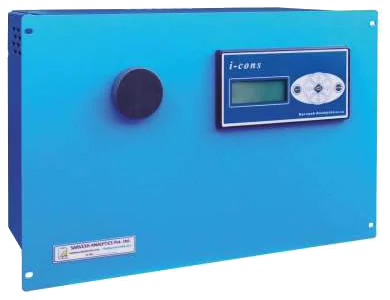
i-Cons
Smart Peltier sample conditioner with diagnostics, auto blowback and Modbus, in a compact 19 inch cabinet.
View i-Cons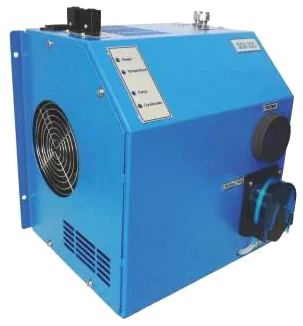
SGI-300 / SGI-320
Peltier sample cooler with integrated pump, filter and condensate detector; SGI-320 for emission monitoring.
View SGI-300 / SGI-320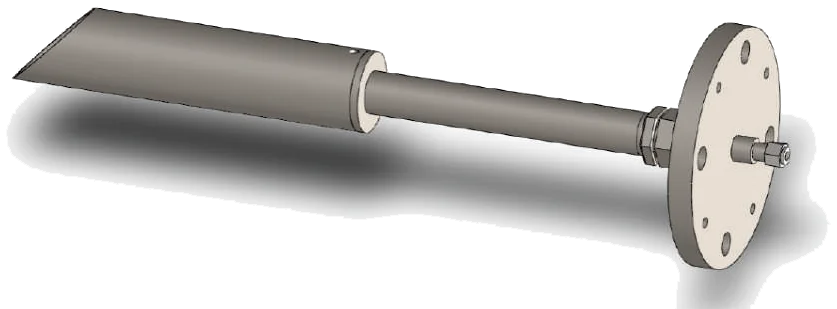
SP and SRP sample probes
Heated and non-heated probes with blowback, and retractable probes, in SS316, Inconel or ceramic.
View SP and SRP sample probesWhere this applies
- Stack and emission monitoring
- Steel plant process gases
- Sampling components and systems
- Sample probes SP-100, SP-200 and SP-300