
In-situ analysers measure the gas where it flows, with no sample line, and suit hot, dusty ducts. Extractive analysers pull a sample to a conditioned analyser, and suit trace measurements and multiple gases. Extractive systems are only as good as their sample handling.
- Define in-situ and extractive analysis
- Match each approach to a typical application
- Say why extractive systems depend on sample handling
In-situ
An in-situ analyser puts the sensor in the process, usually in a duct or stack. There is no sample line, no conditioning, and almost no delay. ACCURRA-Zr is an example, measuring oxygen with a zirconia cell in hot flue gas. In-situ works best for one measurement in a hot, dusty gas where a sample would be hard to condition.
Extractive
An extractive analyser draws a sample through a probe and a line to an analyser, usually after cooling and drying. This lets the analyser sit in a clean location, allows trace-level and multiple measurements, and makes calibration with span gas simple. The price is a sample handling system that must be designed, built and maintained.
Comparison
- In-situ: fast response, no sample line, limited to what the in-situ sensor can measure, harder to calibrate with span gas
- Extractive: many gases and trace levels, analyser in a clean location, calibration with span gas, depends on sample conditioning
- In-situ suits flue gas oxygen. Extractive suits trace oxygen, CO, CO2, methane, moisture, hydrogen and multi-gas emission systems
Where Sarvesh products fit
ACCURRA-Zr is in-situ for flue gas oxygen. ACCURRA-S, ACCURRA-TCD and ACCURRA-Hz are extractive. For hot, wet or dusty samples, probes, i-Cons and SGI-300 condition the gas, and SGI-320 packages the whole extractive chain for emission monitoring.
Rule of thumb
If you need oxygen only, in a hot duct, and want minimal maintenance, choose in-situ. If you need trace levels, other gases, or a clean calibration, choose extractive and invest in the sample system. The sample handling system between the process and the analyser decides how many years of trouble-free measurement you get.
- In-situ measures in the duct with no sample line.
- Extractive pulls a sample to a conditioned analyser and suits trace and multi-gas work.
- An extractive system is only as good as its sample handling.
- Many plants use both.
Check your understanding
Answer in your head or on paper first, then open the answer. Recalling an answer teaches more than rereading.
Name one advantage of in-situ analysis.
No sample line to block or lag, and a fast response, which suits hot dusty ducts.
Why do extractive systems suit trace oxygen in a clean gas?
A clean sample can be conditioned to constant pressure and flow, so a sensitive analyser can be used outside the pipe.
Where do extractive systems most often fail?
In the sample handling: blocked filters, condensation, leaks and long lag times, not the analyser itself.
Key terms
Frequently asked questions
Is in-situ or extractive better?
Neither is better in general. In-situ suits hot flue gas oxygen; extractive suits trace and multi-gas measurements.
Why do extractive systems fail?
Most failures are in the sample path: blocked filters, condensate and pump faults.
Can I measure CO in situ?
Extractive measurement is the usual approach for CO in flue gas.
Which Sarvesh product does extractive emission monitoring?
SGI-320, with a heated probe, heated line, conditioner and analysers.
Related products
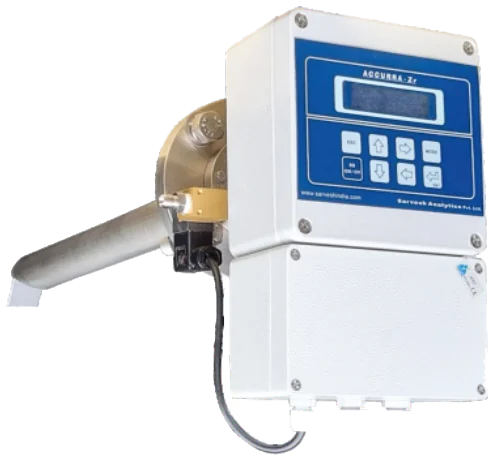
ACCURRA-Zr
Zirconia percent O2 analyser for furnaces and boilers, single-point air calibration, options to 1400 C.
View ACCURRA-Zr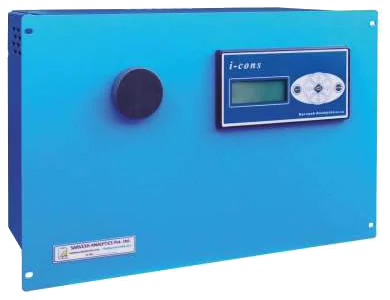
i-Cons
Smart Peltier sample conditioner with diagnostics, auto blowback and Modbus, in a compact 19 inch cabinet.
View i-ConsWhere this applies
- Boiler and furnace oxygen (flue gas)
- Stack and emission monitoring
- ACCURRA-Zr
- Sampling components and systems