
Wet samples must be cooled to a fixed, low dew point so that water leaves as condensate at a controlled place, not in the analyser. A Peltier cooler holds the gas at about a constant temperature and drains the water. Water-soluble gases such as CO2, SO2 and NO2 partly dissolve in the condensate, so cool fast, keep contact time short and keep the cooler cold but not freezing.
- Explain why a wet sample needs a cooler
- Describe how a Peltier cooler works
- Say which gases are lost in condensate and how to limit that
- Plan condensate drainage
Why cool
Hot, wet gas such as flue gas or biogas holds a lot of water vapour. If it cools unpredictably on the way to the analyser, water condenses in lines and fittings, floods filters, wets the cell and dissolves soluble gases at random. A cooler fixes the dew point at a known value, for example 3 to 5 C, and takes the water out at a place designed for it.
A cooled sample has a known dew point, so the analyser always sees the same water fraction, and the reading is stable and can be converted to a dry basis: Dry basis vs wet basis in gas measurement.
How a Peltier cooler works
A Peltier element is a solid-state heat pump. Current flowing through it moves heat from one side to the other, so one side chills and the other warms. The chilled side holds the gas path at a set temperature, with no refrigerant or moving parts. Peltier coolers cannot go as cold as a refrigeration compressor but are compact and need little maintenance. The SGI-300 is a Peltier sample cooler with an integrated pump, filter and condensate detector, and i-Cons is a smart Peltier conditioner with diagnostics, auto blowback and Modbus.
The cooler's capacity limits the inlet temperature and water load it can handle. Pre-cooling or a heated line up to the cooler may be needed.
Soluble gases and condensate
Gases such as CO2, SO2, NO2 and NH3 dissolve in water to some degree. Condensate in contact with the sample takes some of them out, and the effect grows with contact time, surface area and low temperature. To limit it: use a cooler that condenses water quickly and drains it at once, avoid pooling, and keep the dew point no lower than necessary.
A little loss of soluble gas in the cooler is normal and is accounted for in the design. A large or variable loss points to a drain problem, a flooded cooler or a leak.
Drainage and protection
- Drain condensate continuously with a peristaltic pump or a self-draining trap; do not let it back up.
- Fit a condensate detector that stops flow or alarms if water reaches the analyser; SGI-300 includes one.
- Slope lines to the cooler, and keep the cooler vertical as the maker specifies.
- Route condensate to a safe place; it can be acidic or hazardous.
When not to cool
If the target gas is itself water-soluble or you need to measure moisture in the sample, a cooler removes what you want. Then the sample must stay hot and dry-measured by a hot-wet method, or dried by a method that does not strip the target. Ask an engineer before choosing.
- Cool wet samples to a fixed dew point and drain the condensate.
- Peltier coolers are compact and maintenance-light but limited in capacity.
- Soluble gases partly dissolve in condensate; minimise contact time.
- Fit a condensate detector and drain continuously.
Check your understanding
Answer in your head or on paper first, then open the answer. Recalling an answer teaches more than rereading.
Why cool a wet sample before the analyser?
To fix its dew point and remove water in a controlled place rather than in the analyser.
Which gases are lost partly in condensate?
Water-soluble ones such as CO2, SO2, NO2 and NH3.
What protects the analyser if the drain fails?
A condensate detector that alarms or stops the flow.
Key terms
Frequently asked questions
What temperature should a sample cooler run at?
Often 3 to 5 C, low enough to remove most water without freezing. Follow the cooler's specification.
What is the difference between SGI-300 and i-Cons?
SGI-300 is a Peltier cooler with pump, filter and condensate detector; i-Cons is a smart Peltier conditioner with diagnostics, auto blowback and Modbus in a compact 19 inch cabinet.
Can I measure moisture after a cooler?
Only to the cooler's dew point. If you need the process moisture, the sample must not be cooled.
Why does my CO2 reading differ before and after the cooler?
Soluble CO2 partly dissolves in condensate; the difference should be small and steady.
Related products
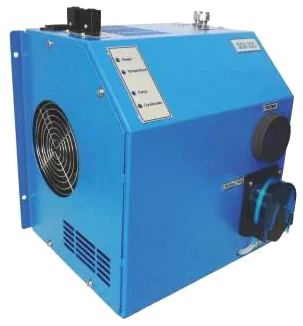
SGI-300 / SGI-320
Peltier sample cooler with integrated pump, filter and condensate detector; SGI-320 for emission monitoring.
View SGI-300 / SGI-320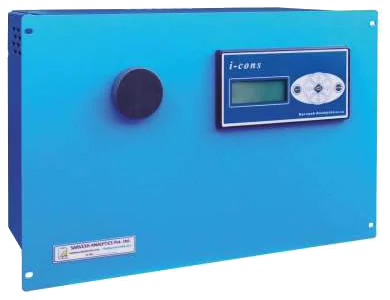
i-Cons
Smart Peltier sample conditioner with diagnostics, auto blowback and Modbus, in a compact 19 inch cabinet.
View i-Cons