
Use stainless steel tube for trace oxygen, moisture and reactive gases, because plastic lets oxygen and water in and out. Keep lines short and narrow, so lag is seconds, not minutes, and heat-trace any line carrying wet gas above its dew point. Leak-test every line at working pressure before connecting the analyser.
- Choose tubing material for a given gas
- Size diameter and length for acceptable lag
- Decide when to heat-trace
- Leak-test a line
Material
| Material | Good for | Avoid for |
|---|---|---|
| Stainless steel 316 | Trace oxygen, moisture, reactive and corrosive-tolerant gases, general use | Strong acids or chlorides at high temperature, where a higher alloy is needed |
| PTFE and PFA | Corrosive gases at moderate temperature | Trace oxygen or moisture: permeable to both, in small amounts |
| Polyethylene, nylon, PVC | Percent-level non-critical gases at room temperature | Trace oxygen, moisture, hot gas |
| Copper | General gases where metal is needed | Gases that react with copper, such as acetylene or ammonia |
If the measurement is in ppm or in dew point, use stainless steel tube.
Why plastic fails for trace gases
Oxygen and water permeate through the walls of most polymers and also adsorb on them. A plastic line passing 5 ppm oxygen in dry nitrogen can gain several ppm of oxygen and take hours to settle after a change. See Trace oxygen measurement and air ingress: ppm done right.
Diameter, length and lag
A short, narrow line is fast; a long, wide one is slow. The lag is the line volume divided by the flow, multiplied by the pressure ratio: a 10 m run of 4 mm bore holds about 126 mL, and at 1 L/min and atmospheric pressure the lag is about 7.5 seconds. Use Gas sample line lag time calculator before you decide.
Try the calculatorGas sample line lag time calculatorA line of 6 mm outside diameter and 1 mm wall (4 mm bore) is a common balance. Very small bore blocks easily with dust or condensate.
Line volume per metre
| Tube | Bore | Volume per metre | Lag of 30 m at 1 LPM |
|---|---|---|---|
| 1/8 inch OD x 0.028 inch wall | 1.75 mm | 2.4 mL | about 4 s |
| 6 mm OD x 1 mm wall | 4.0 mm | 12.6 mL | about 23 s |
| 1/4 inch OD x 0.035 inch wall | 4.6 mm | 16.4 mL | about 30 s |
| 3/8 inch OD x 0.035 inch wall | 7.7 mm | 47.1 mL | about 85 s |
Bore matters by its square: the 3/8 inch line holds nearly three times as much as the 1/4 inch one. ACCURRA-S connects with 1/4 inch OD SS316, and the i-Cons heated hose carries 1/4 inch OD PTFE tube.
Pressure multiplies lag
Lag is calculated for the gas at line pressure. At 5 bar(g), the line holds six times as much gas as at atmosphere, and the same 1 LPM measured at atmosphere takes six times as long to sweep it.
30 m of 1/4 inch tube at 1 LPM: about 30 seconds at atmospheric pressure, about 3 minutes at 5 bar(g). Regulate at the tapping, run the line at low pressure, and the lag returns to 30 seconds. Or keep line pressure and add a fast loop at several LPM: Sample pressure, flow and fast bypass loops.
Add the analyser's own T90 to the line lag to get what the plant sees: Response time, T90 and sample lag in gas analysis.
Temperature: stay above the dew point
If the sample line is colder than the gas dew point, water condenses in it, which dissolves soluble gases such as CO2 and SO2 and floods the line. Heat-trace the line and keep it above the dew point until the sample reaches a cooler that removes water on purpose: Condensate, moisture and sample cooling for gas analysis. Heated lines are used in SGI-320 for exactly this reason.
Heated lines, worked
A flue gas with 12 % water has a dew point of about 50 C; one with 15 % water, about 54 C. Set the line well above the dew point of the wettest gas you expect, with margin for cold spots at supports and entries. The i-Cons heated hose runs at 40 W per metre with Pt100 feedback, in lengths of 30, 45, 60, 75 or 90 m. With the standard pump, i-Cons serves lines up to 60 m; the 8 LPM pump option serves 60 to 90 m.
A heated line that ends a metre short of the cooler, or an unheated union at the probe. Water condenses at the first cold spot, and soluble gases such as SO2 and CO2 go with it.
Joints, slopes and leak testing
- Use as few joints as possible, with compression fittings made up correctly.
- Slope wet lines continuously downhill to a drain; avoid sags where liquid collects.
- Leak-test with the sample gas or an inert gas at working pressure and a leak detection fluid, or pressure-hold test, before commissioning.
- Label and support the line so it is not strained or kinked.
Practice from installation codes
API RP 555 recommends short sample transport, minimum dead volume and sloped, supported tubing; most plant specifications repeat it. For tubing and fittings, use one manufacturer's tube and fittings together, cut and deburr tube square, and make up compression fittings to the maker's turns. Every joint is a potential leak, and at ppm levels a leak dominates the reading: Trace oxygen measurement and air ingress: ppm done right.
- Stainless steel for ppm, dew point and reactive gases; plastic only for non-critical percent measurements.
- Lag rises with volume and pressure; keep lines short and narrow.
- Heat-trace wet lines above the dew point until a deliberate cooler.
- Leak-test before commissioning.
Check your understanding
Answer in your head or on paper first, then open the answer. Recalling an answer teaches more than rereading.
Why is PTFE tube not ideal for trace oxygen?
PTFE is permeable to oxygen in small amounts, which matters at ppm level.
What bore is a good balance of speed and blockage resistance?
Around 4 mm bore (6 mm OD, 1 mm wall) is common.
Why heat-trace a line carrying wet flue gas?
To keep it above the dew point so water does not condense and dissolve soluble gases.
Key terms
Frequently asked questions
What tubing is best for gas analysis?
316 stainless steel for most trace and reactive work.
How long can a sample line be?
As short as practical; the limit is the acceptable lag, which depends on bore, flow and pressure.
Can I use flexible hose?
For short connections to the analyser in non-critical percent measurements. Use metal for ppm and moisture.
Do I need a heated line?
If the sample is wet and hot, yes, until it reaches a cooler. Dry gases at ambient temperature do not.
Related products
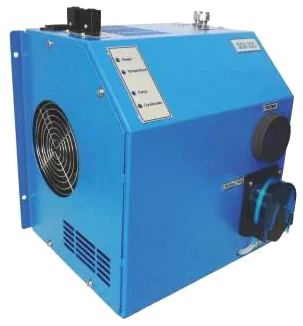
SGI-300 / SGI-320
Peltier sample cooler with integrated pump, filter and condensate detector; SGI-320 for emission monitoring.
View SGI-300 / SGI-320Headline filters
Particulate, coalescing and PTFE membrane filters from Headline Filters, UK, for analyser protection.
View Headline filters