Air is 209,500 ppm oxygen, so a leak of just 0.01 % air adds about 21 ppm to a sample. At ppm levels, air ingress, permeation through plastic tubing, diffusion back up the vent line and residual oxygen in the line dominate the reading. Use metal tube, tight fittings, a purge before measuring, and a vent that stops air diffusing in.
- Estimate how much a small air leak adds to a trace oxygen reading
- List the paths by which oxygen gets into a sample line
- Design a sample path that protects a trace measurement
- Explain why an electrochemical cell needs a purge after air exposure
Why a tiny leak is a big error
Air contains 20.95 % oxygen, which is 209,500 ppm. If a sample contains 0.01 % air by leak, it carries 0.0001 x 209,500 = 21 ppm of oxygen. In a nitrogen stream specified at 5 ppm, a leak of 0.002 % air (one part in 50,000) fills the whole limit.
Treat any oxygen reading above the process expectation as a possible leak first, and a process fault second.
The ways oxygen sneaks in
- Leaks at joints, especially threaded joints and compression fittings loosened by vibration or heat cycles.
- Permeation through tubing. Oxygen diffuses through many plastics and elastomers. Use stainless steel tubing for trace oxygen.
- Back-diffusion through the vent. If the vent is open to air and the sample flow is small, oxygen diffuses upstream against the flow. A longer vent line or a small back-pressure prevents it.
- Dead legs and dead volume hold air from the last time the line was open.
- Residual oxygen in the line after maintenance; purge with the sample.
Worked examples: leaks, flow and purge
A leak into a 1 LPM sample. Air is 209,500 ppm oxygen. A leak of 0.024 mL per minute into 1000 mL per minute of sample adds 209,500 x 0.024 / 1000 = 5 ppm. A leak too small to see with soap solution fills a 5 ppm specification.
Flow dilutes a leak. The same 0.024 mL per minute into 4 LPM adds about 1.3 ppm. Higher flow does not cure a leak, but it makes a fixed leak smaller in ppm, and a step in reading when flow changes is a classic sign of one.
Purging a line from air. With perfect mixing, oxygen falls by a factor of e for each line volume flushed. From 209,500 ppm to 1 ppm takes ln(209,500) = 12.3 volumes. A 10 m line of 4 mm bore holds 126 mL; at 1 LPM that is 1.5 litres and 93 seconds in theory. Fittings, dead legs and oxygen on the walls make the real figure many times longer.
Building the sample path
- Use stainless steel tube and metal-sealed or well-made compression fittings.
- Minimise the number of joints and keep the line short.
- Leak-test with the sample gas at the working pressure before connecting the analyser.
- Purge the line with sample gas for long enough to replace several line volumes: Gas sample line lag time calculator.
- Check the vent for back-diffusion and use a pressure drop or a longer tube if needed.
The analyser's own flow is part of the story: too low a flow makes the system more sensitive to small leaks.
Pressure and the direction of a leak
A line above atmospheric pressure leaks outward, so air enters mainly by diffusion and permeation. A line below atmospheric pressure, for example on the suction side of a pump, draws air in through every imperfect joint. For trace oxygen, keep the whole path under positive pressure and put the pump, if there is one, after the analyser or not at all. The 3015 model has no internal sample pump option for this reason among others.
Run the sample at a steady pressure and flow. ACCURRA-S expects 2 to 10 psig regulated externally and about 1 LPM. Regulate at the tapping, so the line runs at low pressure and low lag.
Protecting an electrochemical cell
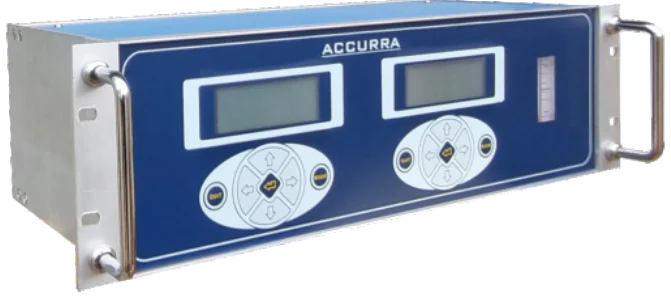
A trace oxygen cell is consumed by its reaction and recovers slowly after exposure to air. Exposing a ppm-level cell to air for a while means a long wait for the reading to return to its true low value. Isolate the cell during maintenance and purge before you reconnect it. The ACCURRA-S catalogue models for trace oxygen (3015) use an electrochemical cell with a range of 0 to 1000 ppm and a minimum range of 0 to 100 ppm: Electrochemical vs paramagnetic oxygen sensors.
Checking your measurement
Two tests catch most problems: close the sample inlet and read the analyser on a purified gas, and compare the sample against a cylinder of certified gas at similar level. If the cylinder reads right but the sample does not, the problem is upstream of the analyser.
A step-by-step leak hunt
- Note the reading at the normal flow.
- Raise the flow by half. If the reading falls, there is probably a leak, which the extra flow dilutes.
- Pressurise the line with the outlet closed and watch the pressure for ten minutes.
- Tighten or remake the joint nearest the analyser first, then work back towards the tapping.
- Read a certified low-ppm cylinder through the same path. If the cylinder reads right at the analyser inlet but wrong through the line, the line is the problem.
A trace oxygen reading that falls slowly for hours after maintenance is usually still purging, not drifting.
Standards and grades
Trace oxygen limits usually come from a product grade or a customer specification: for example industrial and high-purity nitrogen grades, semiconductor process gas specifications, or a pharmacopoeia monograph for medical gases. Read the limit together with the test method it names. Where a cylinder is used as a check standard, its certificate should state the uncertainty and the method of preparation, for example to ISO 6142-1, from a laboratory accredited to ISO/IEC 17025: Calibration gases: choosing, handling and certificates.
- Air is 209,500 ppm oxygen, so tiny leaks create tens of ppm.
- Leaks, permeation, back-diffusion and dead volume are the four paths for oxygen.
- Use stainless steel tube, tight fittings, a leak test and a purge.
- A trace cell recovers slowly after air exposure.
Check your understanding
Answer in your head or on paper first, then open the answer. Recalling an answer teaches more than rereading.
How many ppm of oxygen does 0.005 % air add?
About 10 ppm: 0.00005 x 209,500 = 10.5 ppm.
Why avoid plastic tubing for ppm oxygen?
Oxygen permeates through many plastics and gets into the sample.
What stops back-diffusion through a vent?
A longer vent line, a small back pressure or sufficient flow, so that air cannot diffuse upstream.
Key terms
Frequently asked questions
Why does my trace oxygen reading never reach the expected low value?
Usually a leak or permeation in the sample line, not the sensor. Leak-test and purge.
How long does a trace oxygen cell take to recover after air exposure?
It can take hours at ppm level, depending on the exposure and the cell. Isolate it during maintenance.
Which analyser measures trace oxygen?
ACCURRA-S 3015 covers 0 to 1000 ppm with a minimum range of 0 to 100 ppm.
Can I use plastic tube if the line is short?
At ppm levels, no. Use stainless steel; it is a small cost against the error.