
A furnace atmosphere protects the metal from oxidation or adds carbon to its surface. Endothermic gas is made by partly burning natural gas and is mostly CO, hydrogen and nitrogen; nitrogen-hydrogen and nitrogen-methanol mixes are also used. Trace oxygen, dew point, CO, CO2 and hydrogen are measured to control carbon potential and to prove the atmosphere is protective.
- Name the common furnace atmospheres and what each does
- Explain carbon potential in outline
- Choose the measurement for each control or protection job
- Recognise safety needs during start-up
Why a protective atmosphere
Steel heated in air oxidises and loses carbon from its surface. A furnace atmosphere prevents this or controls it. Different processes want different atmospheres: neutral to avoid any change, reducing to keep bright surfaces, or carburising to add carbon for hardness.
Common atmospheres
| Atmosphere | Made from | Main components |
|---|---|---|
| Endothermic gas (endogas) | Natural gas and a little air over a hot catalyst | About 20 % CO, 40 % H2, balance N2, with small CO2, H2O and CH4 |
| Nitrogen-methanol | Nitrogen with cracked methanol | N2, CO, H2 |
| Nitrogen-hydrogen (HNX) | Nitrogen with a few percent hydrogen | N2 with 2 to 10 % or more H2 |
| Pure nitrogen | Generator or tank | N2 with ppm oxygen |
Composition figures are typical; plants vary.
Carbon potential and dew point
In a carburising atmosphere, the carbon potential is the carbon content that steel would reach at equilibrium with the gas. It is controlled by the balance of CO, CO2, H2O and hydrogen, often measured by an oxygen probe and checked by CO2, CO or dew point. A lower dew point (less water) generally means a higher carbon potential. The analyser readings back up the probe: Carburising and endothermic gas carbon potential.
What to measure
- Trace oxygen in nitrogen and nitrogen-hydrogen atmospheres, to detect leaks: ACCURRA-S 3015.
- Dew point in bright annealing and sintering, M015, often on the same sample as oxygen in a dual-channel analyser.
- Hydrogen in nitrogen-hydrogen mixes: ACCURRA-TCD, with no reference gas: How thermal conductivity gas analysers (TCD) work.
- CO, CO2 and methane in endogas, by NDIR: ACCURRA-S 2030, 6030, 4030.
Sampling from a hot, sooty furnace needs a probe and conditioning: Probes and blowback for hot, dusty and tarry gas.
Safety
Atmospheres containing hydrogen or CO are flammable and toxic. Furnaces are purged with nitrogen before the atmosphere is introduced, and the purge is verified by measuring oxygen: Inerting and purging: how they work and how to prove them. Flame curtains at the furnace doors ignite escaping gas. Treat these as safety functions to be designed by the furnace maker and the plant.
Applications
- Bright annealing of copper tube, stainless steel and wire: Bright annealing of copper tube, stainless steel and wire.
- Powder metallurgy sintering: Powder metallurgy and metal injection moulding sintering.
- Continuous annealing lines with HNX: Continuous annealing and galvanising line atmospheres (HNX).
- Aluminium brazing: Aluminium controlled-atmosphere brazing furnaces.
- Furnace atmospheres protect or deliberately change the metal surface.
- Endogas, nitrogen-methanol and nitrogen-hydrogen mixes are common.
- Carbon potential depends on CO, CO2, H2O and hydrogen balance.
- Measure trace oxygen, dew point, hydrogen, CO and CO2 as the process requires.
Check your understanding
Answer in your head or on paper first, then open the answer. Recalling an answer teaches more than rereading.
What is endothermic gas mostly made of?
CO, hydrogen and nitrogen.
Why measure dew point in a carburising atmosphere?
Water content shifts the carbon potential, so dew point backs up the control.
Why purge a furnace before introducing the atmosphere?
To remove air so that flammable atmosphere does not form an explosive mixture.
Key terms
Frequently asked questions
What is carbon potential?
The carbon content steel would reach at equilibrium with the furnace gas.
What analyser measures hydrogen in nitrogen?
ACCURRA-TCD, by thermal conductivity.
How do you protect against air leaks in a furnace?
Measure trace oxygen and alarm on a rise; maintain seals and positive pressure.
What does the dew point tell you?
How much water is in the atmosphere, which affects oxidising or reducing behaviour.
Related products
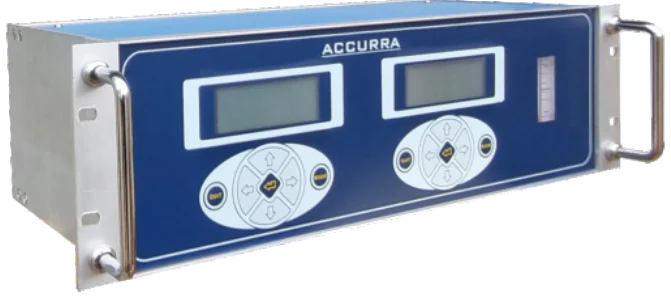
ACCURRA-S
Online analyser for trace, percent and purity O2, CO, CO2, CH4 and dew point; can measure two gases from one sample.
View ACCURRA-SACCURRA-TCD
Thermal conductivity analyser for binary mixtures of H2, He, Ar, N2 and others, with no reference gas.
View ACCURRA-TCD