Fruit keeps breathing after harvest, consuming oxygen and releasing CO2. A controlled-atmosphere (CA) store holds oxygen low and CO2 raised, with cool temperatures, to slow respiration and keep fruit firm for months. Ultra-low oxygen (ULO) stores go lower still. Oxygen and CO2 are measured continuously, and the main challenges are fine resolution at low oxygen and sampling from many rooms.
- Explain respiration and why gas control slows ripening
- State what CA and ULO stores measure
- Identify the measurement challenges
- Know what the analyser must provide
Respiration and ripening
Fruit respires: it uses oxygen, releases CO2 and heat, and ripens. Cooling slows this. Lowering oxygen and raising CO2 slows it much further, and so does removing ethylene, the ripening hormone. The result is fruit that stays crisp for months after harvest, which is why apple, pear and kiwi storage relies on controlled atmospheres.
Typical conditions
Set points depend on the fruit and variety and come from the storage guidelines you follow. As a general guide, CA stores for apples hold oxygen at a few percent and CO2 at a few percent, and ULO stores hold oxygen at around 1 to 2 % or lower. Always use the figures from the technical standard or the grower's advisor: Controlled-atmosphere (CA and ULO) fruit stores.
What is measured
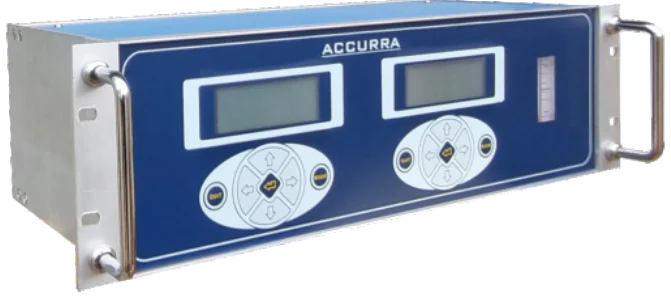
- Oxygen in the room gas, to hold it at the low set point: ACCURRA-S 3030, 0 to 25 %.
- CO2, to hold it at the raised set point: ACCURRA-S 6030.
- Ambient sampling from a room at atmospheric pressure, which needs a pump; some models have none.
- Several rooms are usually sampled in turn by a valve manifold, with a purge between rooms.
Why the analysis is hard
- Resolution at low oxygen. ULO control needs fine resolution near the bottom of the scale, so confirm the range and accuracy, not just the headline range.
- Humid sample. Cold, humid room air condenses when warmed. Manage condensate: Condensate, moisture and sample cooling for gas analysis.
- Respiratory quotient (RQ). Some systems control by the ratio of CO2 produced to oxygen consumed, which makes measurement accuracy matter more.
- Safety. A low-oxygen room is dangerous to enter: Oxygen enrichment and oxygen deficiency hazards.
Choosing the analyser
Tell us the set points, the range and accuracy you need, the number of rooms and the sampling arrangement. A dual-channel ACCURRA-S can read oxygen and CO2 together. The pump question and the accuracy at low oxygen are the first things to confirm: How to specify a gas analyser: A practical checklist.
- CA stores slow respiration with low oxygen, raised CO2 and cool temperature.
- ULO goes lower in oxygen still.
- Measure oxygen and CO2 continuously; use the set points from your guideline.
- Check low-oxygen resolution, pumping and condensate.
Check your understanding
Answer in your head or on paper first, then open the answer. Recalling an answer teaches more than rereading.
What does a CA store do to fruit respiration?
Slows it by holding oxygen low and CO2 raised, with cool temperature.
Why is a pump a question for ambient room sampling?
Some analyser models are supplied without an internal pump, so an ambient-pressure sample needs one.
Why is a low-oxygen store dangerous to enter?
Oxygen deficiency can cause rapid loss of consciousness.
Key terms
Frequently asked questions
What oxygen level is used in ULO storage?
Around 1 to 2 % or lower, depending on the fruit; follow your guideline.
Which analyser measures CA store gas?
ACCURRA-S 3030 for oxygen and 6030 for CO2; confirm range and accuracy for ULO.
Can one analyser serve several rooms?
With a sampling manifold that switches rooms in turn; discuss the arrangement.
Why measure CO2 as well as oxygen?
Because the combination sets the preservation, and the ratio shows respiration.