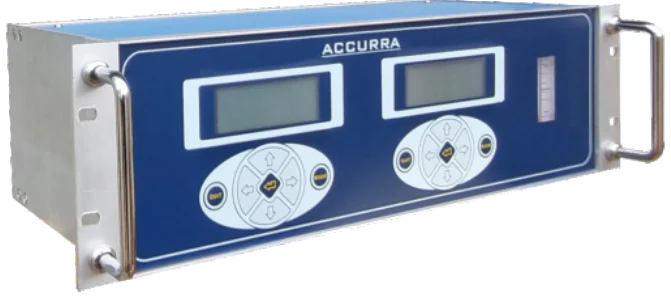
PSA nitrogen generators use carbon molecular sieve to adsorb oxygen from compressed air, giving nitrogen with ppm to percent residual oxygen. PSA and VPSA oxygen generators use zeolite to adsorb nitrogen, giving oxygen of roughly 90 to 95 %, limited by argon. Membranes give nitrogen at lower purity. A trace oxygen analyser on nitrogen, or a percent oxygen analyser on oxygen, proves performance.
- Describe pressure swing adsorption in one paragraph
- State typical purity ranges
- Choose the analyser for each generator type
- Explain why purity falls when flow rises
Pressure swing adsorption (PSA)
Two beds of adsorbent work in turn. Compressed air passes through one bed at high pressure; the bed adsorbs the unwanted component. The other bed is depressurised and releases what it adsorbed. The beds swap every minute or so, giving a continuous product stream.
- Nitrogen PSA: carbon molecular sieve adsorbs oxygen faster than nitrogen. Output is nitrogen, with residual oxygen from a few ppm to a few percent depending on the flow.
- Oxygen PSA: zeolite adsorbs nitrogen. Output is oxygen of roughly 90 to 95 %. Argon is not separated from oxygen by the zeolite, which caps purity near 95 %.
VPSA and membranes
- VPSA (vacuum pressure swing adsorption) regenerates the beds under vacuum, which saves energy at larger scale, mostly for oxygen.
- Membranes are bundles of hollow fibres through which oxygen passes faster than nitrogen, leaving a nitrogen-rich stream. Purity is lower than PSA, with simpler operation. Purity rises when flow falls.
Purity falls when you draw more
In all of these, purity and flow trade off: draw more product and purity falls, because the separation has less time to work. So the output purity changes with demand, and an analyser on the product line shows when it drifts outside specification. See Nitrogen purity and trace oxygen.
What to measure
| Generator | Measure | Analyser |
|---|---|---|
| Nitrogen PSA or membrane | Residual oxygen in ppm or percent | ACCURRA-S 3015 for 0 to 1000 ppm; 3030 for percent |
| Oxygen PSA or VPSA | Oxygen percent, about 90 to 95 % | ACCURRA-S 3130 for 0 to 100 %, or 3090 with compensation |
| Medical oxygen | Oxygen percent against the monograph | 3130 or 3090 for PSA oxygen; 3090 or 3190 for cryogenic purity |
| Any | Dew point of the product | ACCURRA-S M015 |
For medical oxygen, a PSA plant typically makes about 93 % oxygen, and alarms protect against purity falling below the specified level: Medical oxygen plant purity monitoring.
Trace oxygen done right
Because nitrogen from a generator is often sold by ppm oxygen, leaks and permeation in the sample line matter: Trace oxygen measurement and air ingress: ppm done right.
- PSA swaps adsorbent beds to separate air; membranes use selective fibres.
- Nitrogen PSA reaches ppm to percent oxygen; oxygen PSA reaches about 90 to 95 %, capped by argon.
- Purity falls as flow rises.
- Measure trace oxygen on nitrogen and percent oxygen on oxygen.
Check your understanding
Answer in your head or on paper first, then open the answer. Recalling an answer teaches more than rereading.
Why does PSA oxygen not exceed about 95 %?
The zeolite does not separate argon from oxygen, so argon remains with the oxygen.
What happens to purity when a generator is asked for more flow?
Purity falls, because the separation has less time.
Which analyser reads ppm oxygen in generator nitrogen?
ACCURRA-S 3015, 0 to 1000 ppm with a minimum range of 0 to 100 ppm.
Key terms
Frequently asked questions
What is PSA?
Pressure swing adsorption: beds of adsorbent separate gases at pressure and are regenerated by lowering pressure.
How pure is PSA nitrogen?
From about 95 % to 99.999 % nitrogen, depending on design and flow.
How pure is PSA oxygen?
Typically 90 to 95 %.
Do I need an analyser on a generator?
If purity matters, yes. It shows when output drifts out of specification.