
An air separation unit compresses air, removes water and CO2, cools it until it liquefies and distils the liquid into oxygen, nitrogen and argon, which boil at different temperatures. Analysers measure oxygen purity on the product, trace oxygen in nitrogen and argon, and moisture and CO2 at the purifier. Product is sold on purity, so these readings are the quality record.
- Describe the stages of cryogenic air separation
- List the products and their usual quality measures
- Place analysers at the right points
The process in five steps
- Compress filtered air.
- Purify. Remove water and CO2 (which would freeze) in a molecular sieve adsorber.
- Cool the air against the cold products in a heat exchanger until it nears liquefaction.
- Distil in columns: the components boil at different temperatures (nitrogen about minus 196 C, argon about minus 186 C, oxygen about minus 183 C), so nitrogen rises and oxygen collects at the bottom.
- Withdraw products as gas or liquid.
Argon is drawn from a middle section of the column and refined further.
Products and what customers care about
| Product | Typical specification focus |
|---|---|
| Oxygen, gas or liquid | Purity; for cryogenic plants well above 99 % |
| Nitrogen, gas or liquid | Residual oxygen in ppm; moisture |
| Argon | Oxygen and nitrogen impurity in ppm |
| Instrument and plant air | Dew point |
Product is sold on these figures, so a reading is also a commercial record: Accuracy, precision, repeatability and drift in gas analysers.
Where analysers go
- Oxygen purity on the gaseous product line, the storage tanks and the filling station: ACCURRA-S 3090 or 3190, with pressure compensation: Why ambient pressure affects oxygen purity readings.
- Trace oxygen on nitrogen and argon lines: 3015: Trace oxygen measurement and air ingress: ppm done right.
- Moisture on dry product and purifier outlet: M015 dew point: What is dew point and how is it measured.
- CO2 in ppm at the purifier outlet, to check that the adsorber is working.
- Helium and argon purity by thermal conductivity where the mixture is binary: How thermal conductivity gas analysers (TCD) work.
Other impurities, such as hydrocarbons in liquid oxygen, are measured by other methods outside the Sarvesh range.
Liquid draws
Samples drawn from liquid need a vaporiser so that the whole sample becomes gas at once: Sampling cryogenic and liquefied gases: vaporisers.
Bulk and filling
Downstream, tankers, bulk storage and cylinder filling stations rely on purity checks at delivery and at filling. These are covered under gas purity certification: Gas purity certification and cylinder filling.
- Air separation compresses, purifies, cools and distils air.
- Products are sold on purity or ppm impurity, so analyser readings are quality records.
- Place purity, trace oxygen, moisture and CO2 analysers by stream.
- Liquid samples need a vaporiser.
Check your understanding
Answer in your head or on paper first, then open the answer. Recalling an answer teaches more than rereading.
Why are water and CO2 removed before cooling air?
They would freeze and block the equipment.
Which analyser reads oxygen purity with pressure compensation?
ACCURRA-S 3090 or 3190.
Why use a vaporiser on a liquid draw?
So the whole liquid sample becomes gas at once and keeps its composition.
Key terms
Frequently asked questions
What are the products of an air separation plant?
Oxygen, nitrogen and argon, as gas and liquid, often with instrument air.
Which measurements matter most in an ASU?
Oxygen purity, trace oxygen in nitrogen and argon, and moisture.
Why measure CO2 at the purifier?
A rising CO2 shows the adsorber is exhausted and CO2 could freeze downstream.
Do you supply analysers for ASUs?
Yes; see the industrial gas plant pages.
Related products
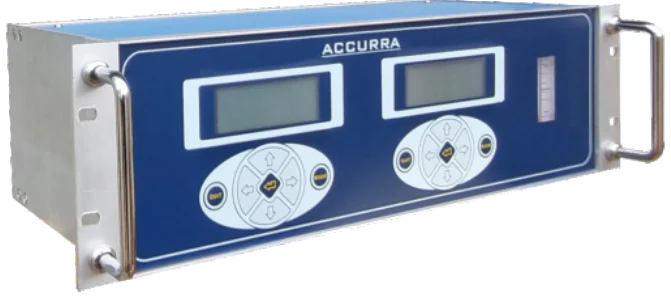
ACCURRA-S 3090
Oxygen purity analyser for 95 to 100 % O2 with ambient pressure and temperature compensation.
View ACCURRA-S 3090ACCURRA-S
Online analyser for trace, percent and purity O2, CO, CO2, CH4 and dew point; can measure two gases from one sample.
View ACCURRA-SSV-200 / SV-400 vaporisers
Sample vaporisers for cryogenic and wet samples with no loss of sample.
View SV-200 / SV-400 vaporisers