
A glove box is a sealed chamber filled with nitrogen or argon in which oxygen and moisture are held at very low levels, often through a circulating purifier that removes both. Battery, materials, chemistry and nuclear work use them. Oxygen in ppm and moisture as dew point or ppm are monitored; the small chamber volume means the analyser's sample draw must be limited or returned.
- Describe how a glove box keeps atmosphere clean
- State typical levels and what limits them
- Explain the small-volume sampling issue
- Choose the measurement
How it works
The chamber is filled with inert gas, and gloves let the user work inside. A circulating blower passes the atmosphere through a purifier, typically a catalyst bed that removes oxygen and a molecular sieve that removes water, so the levels stay low even as small leaks and the outgassing of materials add contamination. Antechambers let items in and out without breaking the atmosphere.
Levels and uses
- Levels from a few ppm down to below 1 ppm of oxygen and moisture are common in high-end boxes.
- Typical uses: lithium battery development, air-sensitive chemistry, metal powders, photovoltaic and OLED research, and some pharmaceutical and nuclear work.
- The target level depends on the material; a few ppm is enough for some, and a fraction of a ppm is needed for others.
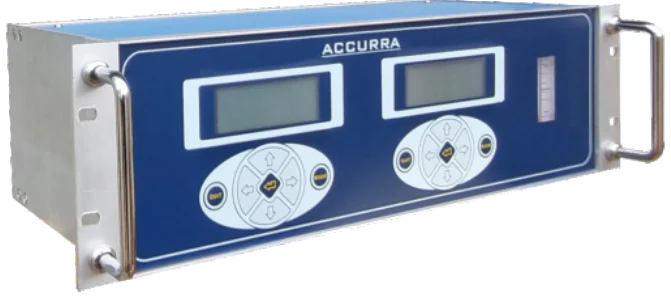
ACCURRA-S 3015 has a minimum range of 0 to 100 ppm. Boxes working at sub-ppm levels need specialised sensors; tell us your target level so we can say whether we can help.
Measuring oxygen and moisture
- Oxygen in ppm: an electrochemical cell such as ACCURRA-S 3015.
- Moisture: dew point or ppm; ACCURRA-S M015 covers minus 80 to plus 20 C.
- Both from one sample: a dual-channel ACCURRA-S 3015 plus M015 reads oxygen and moisture together: Glove boxes and isolators (O2 and moisture).
Trace measurements need leak-tight stainless steel sample lines: Trace oxygen measurement and air ingress: ppm done right.
The small-volume problem
A glove box holds little gas. An analyser that draws 1 L/min removes and vents a large fraction of the atmosphere every minute, so the sample must be returned to the box or the draw kept very small. Models without an internal pump suit a circulating loop; those with one need care. Discuss the sample return with us at the start: Sample pressure, flow and fast bypass loops.
Nuclear and research use
Argon cover gas and glove-box atmospheres in nuclear and research settings are monitored for oxygen and moisture too: Reactor cover-gas and glove-box atmospheres (O2 and moisture in argon), Research furnaces and CVD/ALD labs. Orders are small and technical; we treat each as an application engineering job.
- A circulating purifier holds oxygen and moisture low in a sealed inert chamber.
- Levels from a few ppm to below 1 ppm are used; sub-ppm needs specialised sensors.
- Measure oxygen ppm and moisture; a dual-channel analyser reads both.
- Control or return the analyser's sample draw because the volume is small.
Check your understanding
Answer in your head or on paper first, then open the answer. Recalling an answer teaches more than rereading.
What does a glove-box purifier remove?
Oxygen (catalyst) and water (molecular sieve).
Why is sample draw a problem in a glove box?
The chamber volume is small, so a 1 L/min draw removes a large fraction of the atmosphere each minute.
Which ACCURRA-S measures moisture?
M015, minus 80 to plus 20 C dew point.
Key terms
Frequently asked questions
What oxygen level does a glove box hold?
From a few ppm to below 1 ppm, depending on the box and use.
Can ACCURRA-S 3015 measure 0.1 ppm?
Its minimum range is 0 to 100 ppm; sub-ppm needs other sensors. Tell us your target.
How do I avoid draining the box atmosphere?
Return the sample or limit the flow.
Can one analyser read oxygen and moisture?
A dual-channel ACCURRA-S can read both from one sample.
Related products
Where this applies
- Glove boxes and isolators (O2 and moisture)
- Reactor cover-gas and glove-box atmospheres (O2 and moisture in argon)