
An electrolyser splits water into hydrogen at one electrode and oxygen at the other. Small amounts of each gas cross into the other stream, so hydrogen in oxygen and oxygen in hydrogen are watched to stay far below the 4 % hydrogen explosive limit. Purity and moisture of the product hydrogen are also measured. ACCURRA-TCD reads hydrogen purity; ACCURRA-Hz reads oxygen in hydrogen in a hazardous-area enclosure.
- Describe electrolysis in outline
- Explain gas crossover and why it is the key measurement
- Match the analyser to each stream
- Know what to ask of a supplier for hydrogen projects
How an electrolyser works
Electric current passes through water in a stack of cells. Hydrogen forms at the cathode and oxygen at the anode. Separators keep the gases apart. The main types are alkaline and polymer electrolyte membrane (PEM). Each produces hydrogen at high purity, usually saturated with water, which is dried downstream.
Crossover and why it matters
No separator is perfect. A little hydrogen diffuses into the oxygen stream and a little oxygen into the hydrogen stream. At low load, crossover is relatively larger, since less gas is produced to dilute it. If hydrogen in oxygen rose toward the lower explosive limit of about 4 %, the mixture could burn. Electrolyser systems therefore measure both and trip well below the limit: Flammability, explosive limits and gas safety basics.
What to measure
| Stream | Measurement | Why | Analyser |
|---|---|---|---|
| Oxygen stream | Hydrogen in oxygen | Safety, stay far below the LEL | ACCURRA-TCD (binary hydrogen in oxygen) |
| Hydrogen stream | Oxygen in hydrogen | Safety; also product quality | ACCURRA-Hz, hazardous-area enclosure |
| Product hydrogen | Purity | Product specification | ACCURRA-TCD |
| Product hydrogen | Moisture | Dryer performance | ACCURRA-S M015 where the sample suits |
Alarm and trip values are set by the electrolyser maker and the safety study, not by the analyser supplier.
What goes wrong
- A third gas or moisture shifts a thermal conductivity reading: Cross-Sensitivity and interference in gas analysers.
- Leaks in hydrogen service are dangerous and also let air in.
- Sample lines carry flammable hydrogen to the analyser, so the sample and vent arrangement belong in the hazardous-area design: Hazardous area classification: zones, gas groups, T-Classes.
Safety integrity
We make no SIL claim for our analysers. Where the oxygen-in-hydrogen or hydrogen-in-oxygen measurement is part of a safety function, tell us the requirement at the start: What SIL means for gas analysers, and what it does not.
Further reading
The application pages describe the measurement set: Electrolyser safety and quality, Hydrogen purity and Measuring hydrogen: purity, mixtures and safety limits.
- Electrolysers split water into hydrogen and oxygen across a membrane.
- Crossover puts a little of each gas in the other stream, so hydrogen in oxygen and oxygen in hydrogen are safety measurements.
- Keep hydrogen in oxygen far below 4 %, the lower explosive limit.
- No SIL claim is made; tell us the requirement early.
Check your understanding
Answer in your head or on paper first, then open the answer. Recalling an answer teaches more than rereading.
What is gas crossover?
The small flow of hydrogen into the oxygen stream and oxygen into the hydrogen stream through the separator.
Which measurement protects against a flammable mixture in the oxygen stream?
Hydrogen in oxygen, kept far below the 4 % lower explosive limit.
Why is crossover worse at low load?
Less gas is produced to dilute the crossover, so its share rises.
Key terms
Frequently asked questions
What gases do I measure around an electrolyser?
Hydrogen in oxygen, oxygen in hydrogen, hydrogen purity and moisture.
What alarm level for hydrogen in oxygen?
Set by the manufacturer and your safety study, far below 4 %.
Are ACCURRA-Hz analysers suitable for electrolyser areas?
They are certified for Gas Group IIC, Zone 1 and 2, T6; confirm your zone and requirements.
Do your analysers have SIL?
We make no SIL claim.
Related products
ACCURRA-TCD
Thermal conductivity analyser for binary mixtures of H2, He, Ar, N2 and others, with no reference gas.
View ACCURRA-TCD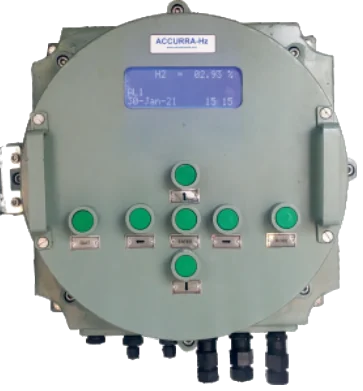
ACCURRA-Hz
Process gas analyser in an enclosure certified for Gas Group IIC, Zone 1 and 2, T6.
View ACCURRA-Hz