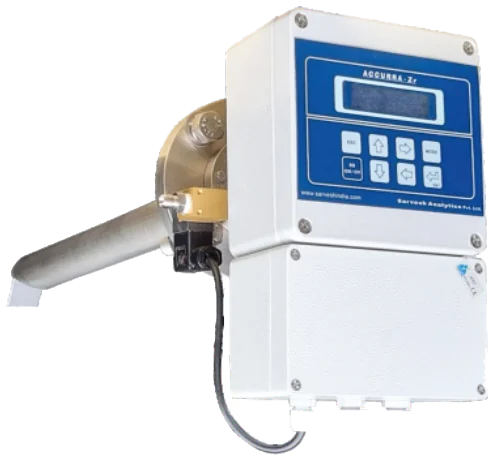
A zirconia analyser measures oxygen with a heated ceramic cell. At high temperature the zirconia conducts oxygen ions, and the voltage across it depends on the ratio of oxygen in the flue gas to oxygen in a reference, usually air. It reads in situ with no sample line.
- Describe how a heated zirconia cell produces a voltage from an oxygen difference
- Explain why the cell is heated and why it is calibrated on air
- List what limits a zirconia reading in a real duct
The cell
Zirconium dioxide, stabilised with a small amount of another oxide, becomes an oxygen-ion conductor when it is hot, typically several hundred degrees Celsius. A cell has electrodes on both sides of a zirconia element. One side sees the flue gas and the other sees a reference gas, usually clean air at 20.9 % oxygen.
The measurement
Because oxygen ions move from the side with more oxygen to the side with less, the cell develops a voltage that depends on the logarithm of the ratio of the oxygen partial pressures on each side (the Nernst relation). With the reference known, the flue gas oxygen follows. A measured temperature corrects the calculation, and the cell is held at a controlled temperature.
The Nernst relation, worked
E = (R x T / 4F) x ln(p reference / p sample)
R is the gas constant, F the Faraday constant and T the absolute cell temperature. With air on the reference side and a cell at 700 C (used here for the arithmetic; cell temperatures vary by design), RT/4F is about 21 mV:
| Flue gas oxygen | Cell voltage at 700 C |
|---|---|
| 20.95 % (air) | 0 mV |
| 10 % | 15.5 mV |
| 5 % | 30.0 mV |
| 3 % | 40.7 mV |
| 2 % | 49.2 mV |
| 1 % | 63.8 mV |
| 0.1 % | 112 mV |
Two things follow. The signal is logarithmic, so the cell is most sensitive at low oxygen, exactly where combustion control runs. And the voltage depends on temperature, so the cell temperature is controlled and measured.
In-situ measurement
ACCURRA-Zr mounts on the duct and draws the flue gas through a guide tube to a sensor just outside the wall, so the measurement is fast, the sensor is protected from dust and temperature swings, and there is no sample line to condense, block or leak. Dust is handled by built-in automatic blowback, with an option for high dust loads. A high-temperature option allows process temperatures up to 1400 C.
Wet basis: why zirconia and an extractive analyser disagree
A zirconia probe measures the flue gas as it is, water vapour included: a wet basis. An extractive analyser behind a cooler measures gas from which the water has been removed: a dry basis. The two differ by the water fraction.
Natural gas flue gas with 3.0 % oxygen dry and about 15 % water reads 3.0 x 0.85 = 2.55 % on a zirconia probe. Neither instrument is wrong. State the basis on every figure: Dry basis vs wet basis in gas measurement.
The ACCURRA-Zr datasheet gives the process window: flue gas 200 to 500 C, dust up to 10 g/Nm3, velocity 5 to 20 m/s, with probes for up to 1400 C and high dust as options. Probe lengths are 300, 500 or 1000 mm on a 2 inch ANSI flange. Mount the probe horizontally; ACCURRA-Zr is not suitable where the flue gas flows from top to bottom.
Calibration
Calibration is a single point with air. Because air has a known oxygen content, no span gas cylinder is needed for routine checks, which makes zirconia economical to maintain.
Limits to know about
Zirconia measures oxygen that is available at the hot cell. Unburnt fuel in the flue gas, such as carbon monoxide or hydrogen, reacts with oxygen at the cell and gives a lower reading than the gas contains. That is the reason zirconia is paired with a CO measurement where combustion is poor. It is also not the right tool for trace oxygen in process gas; use an electrochemical analyser for that.
Worked example: combustibles at the cell
Carbon monoxide burns at the hot cell: 2 CO + O2 gives 2 CO2. Every 1000 ppm of CO consumes 500 ppm of oxygen, so the reading is about 0.05 % low. That is small at 3 % oxygen, but in a rich upset with several thousand ppm of CO the oxygen reading can look healthier than the fire is. Measure CO alongside oxygen where combustion can go rich: Combustion, excess air and flue gas oxygen explained.
Sensor life and fuels
| Fuel or gas | Expected sensor life, ACCURRA-Zr datasheet |
|---|---|
| Clean gas | Above 10 years |
| Low-sulphur natural gas | Above 5 years |
| Biomass or coal | Above 3 years |
Oil, gas and natural gas run without blowback; coal and bagasse use blowback, which also runs before every calibration. The datasheet gives repeatability better than 1 % of full scale and a T90 below 15 seconds, over 0.1 to 21 % oxygen. The standard for stating the performance of high-temperature oxygen analysers is IEC 61207-2.
- Zirconia measures oxygen in situ, with no sample line to block.
- The cell compares flue gas oxygen with a reference, usually air.
- Unburnt fuel can consume oxygen at the hot cell and make it read low.
- Probe choice depends on dust and temperature.
Check your understanding
Answer in your head or on paper first, then open the answer. Recalling an answer teaches more than rereading.
Why must a zirconia cell be heated?
Zirconia conducts oxygen ions only at high temperature. Below that it gives no useful signal.
Why is single-point calibration on plain air enough?
The cell's response to the ratio of oxygen between flue gas and reference is well defined, and air is a convenient, known 20.9 % reference.
A boiler burns rich and the analyser reads 0.2 % oxygen. What else might the cell be telling you?
That combustible gases may be present and reacting at the cell, so the reading may be lower than the true oxygen. Check CO or combustibles, not just oxygen.
Key terms
Frequently asked questions
How does a zirconia oxygen sensor work?
A heated zirconia cell conducts oxygen ions and produces a voltage that depends on the oxygen difference between the flue gas and a reference air stream.
Why does zirconia need heating?
Zirconia conducts oxygen ions only at high temperature, so the cell is heated to a controlled working temperature.
Can a zirconia analyser read low if there is unburnt fuel?
Yes. Combustibles consume oxygen at the hot cell, so the reading is lower than the true oxygen content.
How is ACCURRA-Zr calibrated?
With plain air at a single point.