
Carbon dioxide is measured by NDIR over ppm to 100 % ranges. Carbon monoxide is measured by NDIR or, at ppm level, by electrochemical cells. CO shows combustion quality and furnace atmosphere; CO2 shows fermentation, ripening, storage, biogas quality and combustion efficiency. Water vapour, and hydrogen on electrochemical CO cells, are the main interferences.
- Choose NDIR or electrochemical for CO and CO2 at a given range
- List the main uses of each gas
- Name the interference that most often affects each method
Carbon dioxide
CO2 absorbs infrared strongly, so NDIR is the natural method over the whole range from ppm to 100 %. ACCURRA-S 6030 reads 0 to 20 % or 0 to 100 % CO2 by NDIR. Typical uses: fermenter off-gas and breweries, fruit stores and ripening rooms, biogas and landfill gas, dry ice and food-grade CO2 plants, and combustion efficiency.
Carbon monoxide
CO also absorbs infrared and is measured by NDIR at percent level. At ppm level in combustion and furnace atmospheres, electrochemical CO cells are widely used. CO is read for two reasons: as a measure of incomplete combustion (it rises when air is short), and as a safety variable, since CO is toxic and flammable. Typical uses: boiler and kiln combustion trim, heat treatment atmospheres, steel plant gases and filter protection systems.
A CO analyser used for process control is not a personal gas detector. Safety detection for people is a different product class.
Interferences
- Water vapour affects NDIR readings and causes condensation in the cell. Cool and dry the sample to a stable dew point.
- Hydrogen reads as CO on an electrochemical CO cell; where hydrogen is present, choose NDIR or a cell with a hydrogen filter.
- Other absorbers such as hydrocarbons overlap with CO2 or CO bands in some analysers; choose a detector with a suitable filter.
See Cross-Sensitivity and interference in gas analysers.
Where each gas tells you something
| Process | Gas | What it shows |
|---|---|---|
| Boiler or kiln | CO and O2 | Whether combustion is complete and efficient |
| Fermenter | CO2 with O2 | Metabolic activity; oxygen uptake and CO2 evolution rates |
| Fruit store | CO2 and O2 | Respiration; controlled atmosphere set points |
| Biogas | CO2 with CH4 | Gas quality and digester health |
| Furnace atmosphere | CO, CO2 | Carbon potential and atmosphere control |
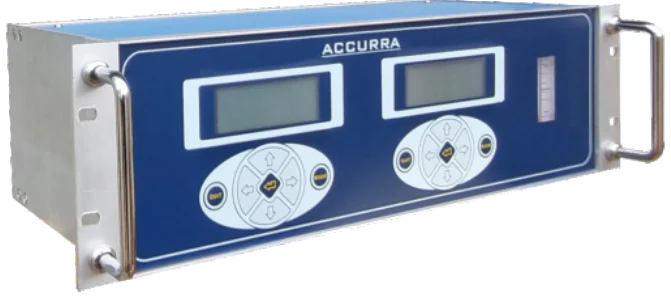
Several of these are explained in the process primers track. ACCURRA-S can read two gases from one sample, for example CO2 with CH4 or O2 with CO2, in one enclosure.
- NDIR is the standard for CO2 and for percent CO.
- Electrochemical cells suit ppm CO.
- Water vapour is the main NDIR interference; hydrogen the main one for CO cells.
- Process CO and CO2 reveal combustion and biological activity.
Check your understanding
Answer in your head or on paper first, then open the answer. Recalling an answer teaches more than rereading.
Why can NDIR measure CO2 but not nitrogen?
CO2 absorbs infrared and nitrogen does not.
A CO cell reads high in a hydrogen-rich furnace atmosphere. Why?
Hydrogen cross-sensitivity: the cell reads hydrogen as CO.
Name two process reasons to measure CO in flue gas.
To detect incomplete combustion for efficiency and emissions, and as a safety signal in front of a filter or precipitator.
Key terms
Frequently asked questions
Which ACCURRA-S models measure CO2?
6030 (0 to 20 % or 0 to 100 %) and 6015 for ppm ranges, by NDIR.
Which models measure CO?
2015 for ppm ranges and 2030 for percent ranges. Confirm ranges against the datasheet.
Can one analyser read both CO and CO2?
Yes, in a dual-channel enclosure from one sample.
Why is the sample cooled before an NDIR analyser?
To remove condensing water that would disturb the optical path and the reading.
Related products
Where this applies
- Fermenter and bioreactor off-gas
- Boiler and furnace oxygen (flue gas)
- ACCURRA-S carbon monoxide analysers
- ACCURRA-S carbon dioxide analysers