
Dew point is the temperature at which moisture in a gas begins to condense. In dry process gas it is quoted instead of ppm: minus 60 C is about 10 ppm of water vapour at atmospheric pressure, and every 10 degrees lower is roughly three times drier.
- Explain dew point as the temperature at which moisture starts to condense
- Convert a dew point to ppm by volume at a stated pressure
- Say why a dew point needs a pressure attached to it
- Name the habits that give a stable moisture reading
What dew point means
If you cool a gas that contains water vapour, you reach a temperature where the vapour starts to condense into liquid or, below zero, frost. That temperature is the dew point. A drier gas has a lower dew point. The dew point does not depend on the temperature of the gas now, only on how much water vapour it holds at its pressure.
From dew point to ppm
Dew point and water content are two ways to say the same thing. At atmospheric pressure, the saturation vapour pressure of water over ice gives about 6000 ppm by volume at 0 C, about 1000 ppm at minus 20 C, about 130 ppm at minus 40 C, about 11 ppm at minus 60 C, and about half a ppm at minus 80 C. Each 10 degrees colder is roughly a factor of three drier.
Worked conversions
| Dew point at 1 atm | Water vapour, ppm by volume | Typical gas |
|---|---|---|
| +20 C | about 23,000 | Ambient air on a humid day |
| +3 C | about 7500 | Gas saturated at 3 C |
| -20 C | about 1000 | Instrument air, minimum |
| -40 C | about 127 | Desiccant-dried compressed air |
| -60 C | about 11 | Dry nitrogen |
| -70 C | about 2.6 | Very dry process gas |
| -80 C | about 0.5 | Ultra-dry gas, the bottom of the M015 range |
The steep curve has a practical side. The M015 datasheet accuracy of +/- 2 C at minus 60 C is a factor of about 1.3 either way in ppm: 11 ppm could be 8 or 14. That is good engineering accuracy for a dryer outlet, but not a laboratory reference.
Pressure dew point and atmospheric dew point
A dew point has to be quoted with a pressure. The dew point of a gas at line pressure is higher than the dew point the same gas has after it expands to atmosphere, because moisture concentration falls with pressure. Always say which one a specification means before comparing instruments.
Worked example: compressed air
A refrigerant dryer delivers air at 7 bar(g) with a pressure dew point of +3 C. The water content at line pressure is the saturation vapour pressure at +3 C, 757 Pa, divided by the absolute pressure, 8.01 bar: about 946 ppm. Expanded to atmosphere, the same 946 ppm has a dew point of about minus 21 C.
A desiccant dryer at minus 40 C pressure dew point and 7 bar(g) gives about 16 ppm, an atmospheric dew point of about minus 57 C.
Comparing a pressure dew point from one instrument with an atmospheric dew point from another, and concluding that one of them is 20 degrees wrong.
How trace dew point is measured
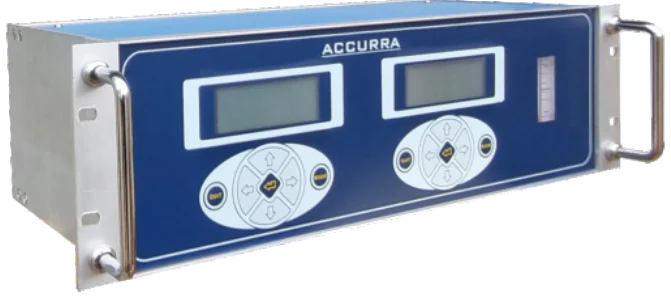
Online trace moisture analysers use a sensor whose electrical properties change with the amount of water vapour in contact with it. ACCURRA-S M015 uses a ceramic sensor and covers minus 80 to plus 20 C dew point, with an accuracy of plus or minus 2 C and repeatability of 1 C according to the catalogue. It can display dew point or ppm.
Reference methods such as chilled mirrors are used in laboratories and for calibration, but they are bulky and need skilled operation, which is why sensor-based analysers do the continuous online work.
The ISO 8573-1 classes
Compressed air quality is specified to ISO 8573-1, which gives humidity classes by pressure dew point:
| Class | Pressure dew point |
|---|---|
| 1 | minus 70 C or lower |
| 2 | minus 40 C or lower |
| 3 | minus 20 C or lower |
| 4 | +3 C or lower |
| 5 | +7 C or lower |
| 6 | +10 C or lower |
Instrument air is commonly specified to class 2 or 3; breathing and pharmaceutical air often to class 2. M015 covers minus 80 to plus 20 C, so it spans every class. Measure at line pressure where the class is stated as a pressure dew point, or convert: Compressed air quality and dew point (ISO 8573-1).
Why moisture is the slowest gas to measure
Water molecules stick to surfaces. When a dry gas flows through a new line, the walls give up and take up moisture until they reach equilibrium, which slows the reading and can bias it. The catalogue gives a response of about 2 minutes from dry to wet at 5 LPM for M015, and settling from wet to dry takes longer.
- Use stainless steel tube, not plastic, which holds and releases moisture
- Keep the sample line short and avoid dead legs
- Purge the line before reading after any maintenance
- Use the sensor bypass valve during start-up and purging so the sensor is not saturated
Getting a stable reading
Moisture is the slowest measurement in gas analysis because water adsorbs on every surface it meets. Three habits shorten the wait:
- Purge first. After maintenance, flow sample through the line with the sensor isolated by the M015 sensor bypass valve, so the sensor is not soaked by wet air while the line dries.
- Keep flow steady. The datasheet response of about 2 minutes from dry to wet is at 5 LPM. Lower flow means slower drying of the line.
- Use clean stainless steel. Electropolished SS316 releases water fastest; plastic tube and rubber hose hold it for hours.
Field calibration is not possible on M015. Plan how the sensor will be verified, for example against a chilled mirror reference, before it is ordered: Moisture measurement methods compared for dry gas.
- Dew point and ppm are two ways of stating the same water content.
- Each 10 degrees colder is roughly three times drier.
- Quote whether the dew point is at line pressure or at atmospheric pressure.
- Use stainless steel tube and short lines; plastic holds moisture.
Check your understanding
Answer in your head or on paper first, then open the answer. Recalling an answer teaches more than rereading.
Roughly how many ppm of water is a dew point of minus 40 C at atmospheric pressure?
About 130 ppm by volume. Minus 20 C is about 1000 ppm and minus 60 C is about 11 ppm.
A gas has a dew point of minus 30 C at 7 bar. Is its dew point at atmospheric pressure higher or lower?
Lower. Expanding the gas to atmospheric pressure dilutes the water vapour, so the atmospheric dew point is lower than the line-pressure dew point.
Why does a dry-gas moisture reading take a long time to settle after maintenance?
Water molecules stick to tube walls and fittings. The walls must reach equilibrium with the dry gas before the sensor sees a true value, so purge first and use stainless steel.
Key terms
Frequently asked questions
What dew point is dry enough for nitrogen?
It depends on the use. Heat treatment and electronics lines often specify dew points well below minus 40 C. Your process specification sets the limit.
Is a lower dew point always better?
A lower dew point is drier, but cost rises as you dry further. Specify the dew point the process needs.
How do I convert dew point to ppm?
Use the saturation vapour pressure at the dew point divided by the total pressure. At atmospheric pressure, minus 60 C is about 11 ppm by volume.
Can I calibrate dew point on site?
No. Field calibration is not possible on M015; ask us how the sensor is checked and recalibrated.
Related products
Where this applies
- Dew point and trace moisture in process gases
- Nitrogen purity and trace oxygen
- Semiconductor and electronics gas purity
- ACCURRA-S M015 moisture analyser
- Dual gas trace oxygen and moisture