
Hydrogen purity and hydrogen in nitrogen or argon are measured by thermal conductivity, because hydrogen conducts heat about seven times better than most gases. The safety measurement is oxygen in hydrogen, since hydrogen burns from 4 % in air. Measure binary mixtures with a thermal conductivity cell, watch for a third gas, and treat the sample line as a hazardous-area system.
- Choose the right measurement for hydrogen purity, hydrogen in a mixture and oxygen in hydrogen
- List the interferences and installation issues specific to hydrogen
- State the flammability limits that drive hydrogen safety
Three different measurements
- Hydrogen purity or hydrogen in a binary background (for example in nitrogen, argon or oxygen): thermal conductivity, as in ACCURRA-TCD. See How thermal conductivity gas analysers (TCD) work.
- Oxygen in hydrogen (trace to percent): electrochemical or paramagnetic oxygen analyser in a hazardous-area enclosure such as ACCURRA-Hz. This is the safety measurement around electrolysers.
- Hydrogen leak detection in air: a gas detector at the LEL, a different product class from process analysers.
Why oxygen in hydrogen matters
Hydrogen burns in air from about 4 % up to about 75 % by volume, an extremely wide range, and ignites with very little energy. Electrolysers and hydrogen systems are designed so that oxygen in the hydrogen stream stays far below the point where the mixture could burn, and a continuous oxygen analyser provides the alarm. See Flammability, explosive limits and gas safety basics and Hydrogen electrolysers and gas analysis: what to measure.
What goes wrong in hydrogen sampling
- A third gas. Methane, CO2 or helium in the sample shifts a thermal conductivity reading: Cross-Sensitivity and interference in gas analysers.
- Moisture. Wet hydrogen has a different conductivity from dry. Hold or remove moisture.
- Leaks. Hydrogen leaks through very small gaps. Leak-test every joint.
- Materials and pressure. Choose tubing and fittings rated for hydrogen service and pressure.
- Hazardous area. Analysers in classified areas need suitable enclosures: Hazardous area gas analysers explained. Gas Group IIC covers hydrogen.
Choosing an analyser
| Question | Answer |
|---|---|
| Hydrogen purity in nitrogen, argon or oxygen, safe area | ACCURRA-TCD |
| Oxygen in hydrogen, hazardous area | ACCURRA-Hz (Gas Group IIC, Zone 1 and 2, T6) |
| Hydrogen in a multi-component mix | Discuss with an engineer; a thermal conductivity cell assumes two components |
| SIL-rated measurement | We make no SIL claim; tell us the requirement |
- Hydrogen purity and binary mixtures use thermal conductivity.
- Oxygen in hydrogen is the safety measurement and needs a hazardous-area enclosure.
- Hydrogen burns from about 4 to 75 % in air; Gas Group IIC applies.
- A third gas, moisture and leaks are the usual problems.
Check your understanding
Answer in your head or on paper first, then open the answer. Recalling an answer teaches more than rereading.
Which technology measures hydrogen purity, and why?
Thermal conductivity, because hydrogen conducts heat far better than the usual background gases.
Why is oxygen in hydrogen monitored around electrolysers?
To keep the stream below a flammable mixture and trigger an alarm if oxygen rises.
What gas group covers hydrogen?
Group IIC, the most demanding.
Key terms
Frequently asked questions
How do you measure hydrogen purity online?
With a thermal conductivity analyser, for a binary mixture. ACCURRA-TCD needs no reference gas.
Can hydrogen be measured next to methane?
Not reliably by thermal conductivity alone, since methane changes the reading. Ask an engineer about the composition.
What range of hydrogen can ACCURRA-TCD measure?
0 to 100 % depending on the background gas, per the application notes.
Is ACCURRA-TCD suitable for hazardous areas?
Use ACCURRA-Hz for oxygen in hazardous areas. Tell us your area classification for other measurements.
Related products
ACCURRA-TCD
Thermal conductivity analyser for binary mixtures of H2, He, Ar, N2 and others, with no reference gas.
View ACCURRA-TCD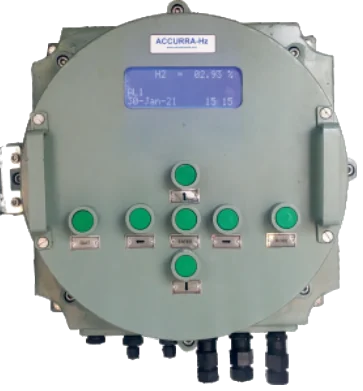
ACCURRA-Hz
Process gas analyser in an enclosure certified for Gas Group IIC, Zone 1 and 2, T6.
View ACCURRA-Hz