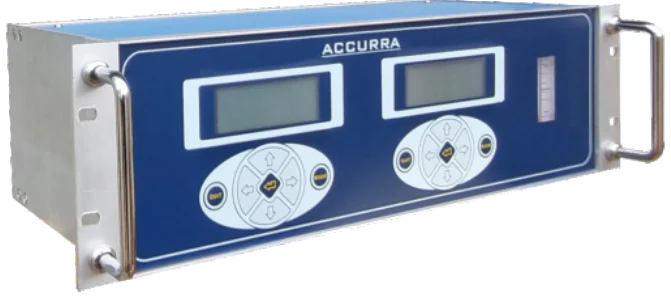
Online dry-gas moisture is usually measured with a ceramic or capacitive sensor that responds to adsorbed water. Chilled mirrors give a reference dew point but need skilled use. Quartz crystal, electrolytic and laser methods reach lower or cleaner measurement in special cases. All of them are limited by the sample line, because water sticks to surfaces.
- Describe how each moisture method works in one sentence
- Match method to dew point range and use
- Explain why sample plumbing dominates moisture accuracy
The methods
| Method | How it works | Good for | Limits |
|---|---|---|---|
| Ceramic or aluminium oxide sensor | Water adsorbs in pores; electrical capacitance or impedance changes | Wide online range of dry gas; ACCURRA-S M015 covers minus 80 to plus 20 C | Slow in very dry gas; needs periodic checking |
| Polymer capacitive sensor | Water changes the dielectric of a polymer film | Humidity in air and moderately dry gas | Not suited to very low dew points; contaminants affect it |
| Chilled mirror | A mirror is cooled until dew or frost forms; an optical detector sees it | Reference measurements and calibration labs | Bulky, needs clean gas and skilled operation |
| Quartz crystal microbalance | A hygroscopic coating on a crystal changes its vibration frequency | Trace moisture in clean gases | Needs clean gas; drift if the coating is contaminated |
| Electrolytic cell (phosphorus pentoxide) | Water is absorbed and electrolysed; the current measures the water | Trace ppm moisture in dry gas | Consumes the sample water; contamination ruins the cell |
| TDLAS | Laser absorption on a water line | Trace moisture in pipelines and clean gas | Costly; not in the Sarvesh range |
Ceramic sensors dominate online process moisture because they are rugged and cover a very wide range. Other methods are used as references or in niche cases.
The sensor is not the limit, the plumbing is
In dry gas, a thin film of water on every surface is exchanged with the gas. A new, wet or porous line gives up water slowly and the reading stays too high. The reading also lags when the dew point changes. Use stainless steel, short lines and few fittings. Avoid plastic and rubber, which absorb and release water. See Sample lines: materials, length, diameter and lag.
Blaming the sensor for a slow or high reading before checking the tubing, joints and leaks. Ambient air leaking in at a joint can be thousands of times wetter than the gas.
Pressure and calibration
A sensor reads at the pressure of the sample passing it. A dew point at line pressure and a dew point at atmosphere differ by many degrees: see Dew point to ppm calculator for gases. Dew point calibration needs a reference such as a chilled mirror or a controlled humidity source; field calibration is not possible on ACCURRA-S M015, so ask us for the calibration approach before ordering.
Choosing
- Compressed air, instrument air, nitrogen at plus 20 to minus 70 C: ceramic sensor.
- Reference or audit check: chilled mirror, used by a calibration laboratory or skilled technician.
- Below minus 70 C or in clean trace gas: ask about the dew point range needed and consider other methods alongside a ceramic sensor.
- Natural gas pipelines: laser or specialised methods; outside the Sarvesh range.
- Ceramic sensors cover the wide online dew point range; chilled mirrors are the reference.
- Water sticks to surfaces, so tubing and joints dominate accuracy and speed.
- State whether a dew point is at line or atmospheric pressure.
- Ask about the calibration approach before ordering.
Check your understanding
Answer in your head or on paper first, then open the answer. Recalling an answer teaches more than rereading.
Which moisture method is the usual laboratory reference?
The chilled mirror.
Why use stainless steel for moisture sample lines?
Plastic and rubber absorb and release water, which slows and biases the reading.
A leak at a fitting raises the reading. Why so much?
Ambient air carries thousands of ppm of water, far more than dry process gas, so a tiny leak changes a dry reading a lot.
Key terms
Frequently asked questions
What is the most accurate way to measure dew point?
A chilled mirror hygrometer is the usual reference, but it needs clean gas and skilled operation.
Can I measure dew point with a humidity sensor?
Relative humidity sensors suit ambient air. Dry process gas needs a sensor made for low dew point.
Why does my moisture reading drift after maintenance?
The tubing re-wets when opened to air and takes time to dry. Purge before reading.
Which range does ACCURRA-S M015 cover?
Minus 80 to plus 20 C dew point with a ceramic sensor, per the datasheet.