
An NDIR (non-dispersive infrared) analyser shines infrared light through a sample and measures how much a target gas absorbs. It measures CO, CO2 and methane accurately and stably, but cannot measure oxygen, hydrogen or nitrogen, which do not absorb infrared.
- Explain how infrared absorption gives a gas concentration
- List which gases NDIR can and cannot measure
- Name the common causes of NDIR error
How it works
An infrared source shines through a sample cell. Gases made of two or more different atoms, such as CO, CO2 and CH4, absorb infrared light at wavelengths specific to them, and the more of the gas there is, the more light is absorbed. An optical filter selects the wavelength of interest and a detector measures the light that arrives. The absorption gives the concentration.
Beer-Lambert, worked
I = I0 x exp(- k x c x L)
I0 is the light entering the cell, I the light leaving it, c the concentration, L the path length and k an absorption coefficient for that gas and wavelength band. The detector sees the ratio I / I0, so absorption grows quickly at first and then flattens: doubling the concentration does not double the absorbed light.
Suppose a cell absorbs 10 % of the light at 1000 ppm. At 2000 ppm it absorbs 1 - 0.9 squared = 19 %, not 20 %; at 10,000 ppm, 65 %, not 100 %. The analyser stores a linearisation curve made at the factory, which is why the span gas should sit near the working range and why a single-point check at the top of a wide range does not prove the bottom.
The path length sets the range. A long cell sees ppm; a short cell keeps percent levels on the useful part of the curve. That is why ppm and percent models are different instruments, for example 6015 for 0 to 5000 ppm CO2 and 6030 for 0 to 20 % or 0 to 100 %.
Why it is called non-dispersive
The light is not spread out into a spectrum by a prism or grating. Instead a filter or the gas itself selects the wavelength band. That keeps the instrument simple and robust.
What it can and cannot measure
NDIR measures gases whose molecules absorb infrared: carbon monoxide, carbon dioxide, methane and other hydrocarbons. It cannot measure oxygen, hydrogen, nitrogen or the noble gases, whose molecules do not absorb at these wavelengths. Those are measured by other methods, such as electrochemical, paramagnetic and thermal conductivity.
In ACCURRA-S
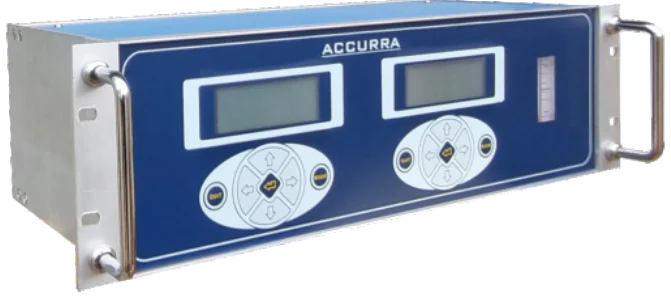
ACCURRA-S uses NDIR for carbon dioxide from 0 to 5000 ppm (6015) and from 0 to 20 % or 0 to 100 % (6030), for methane from 0 to 100 % (4030), and for carbon monoxide at percent level (2030). The catalogue gives sensor life above 5 years for these models, compared with an electrochemical cell which is consumed.
Datasheet figures, read
| Model | Gas and range | Accuracy | T90 at 1 LPM |
|---|---|---|---|
| 6015 | CO2, 0 to 5000 ppm | 1 % of full scale: +/- 50 ppm | Below 60 s |
| 6030 | CO2, 0 to 20 % or 0 to 100 % | +/- 1 % of full scale | Below 60 s |
| 4030 | Methane, 0 to 100 % | 2 % of full scale | Below 45 s |
| 2030 | CO, 0 to 100 % | 2 % of full scale | Below 30 s |
Ambient air carries about 420 ppm CO2. On 6015, the +/- 50 ppm band is about 12 % of that reading: fine for a fermenter off-gas trend, coarse for checking ambient air. For ppm carbon monoxide the electrochemical 2015 (0 to 1000 ppm) is the right model, not NDIR: Measuring carbon monoxide and carbon dioxide online.
What affects accuracy
Water vapour can absorb in overlapping bands and condense on optics, so the sample should be dry and non-condensing. Dust scatters light, so the sample is filtered. Pressure and temperature change the absorption, so the measurement is temperature compensated, and sample pressure is regulated.
Pressure, water and the reference
- Pressure. Absorption depends on the number of molecules in the beam, so a 1 % rise in cell pressure gives roughly a 1 % rise in reading. Regulate the inlet and keep the outlet free.
- Water. Water vapour absorbs across much of the infrared. A filter on the CO2 or CH4 band reduces the effect; a dry sample removes it, and keeps liquid off the windows.
- Ageing. Sources dim and windows foul. Most NDIR benches use a reference wavelength or a reference detector to cancel this, which is why the datasheet gives sensor life above 5 years.
- Background. Hydrocarbons other than methane absorb near the methane band and read partly as methane. Name them when you specify: Cross-Sensitivity and interference in gas analysers.
For stack measurements, NDIR is the basis of the European reference method for carbon monoxide, EN 15058, and of many certified emission analysers under EN 15267: Emission monitoring (CEMS) basics: what a system does.
- NDIR measures gases that absorb infrared: CO, CO2, methane and others.
- It cannot measure oxygen, hydrogen or nitrogen.
- Water vapour and a dirty cell are the usual error sources.
- NDIR is stable and has no consumed sensing element.
Check your understanding
Answer in your head or on paper first, then open the answer. Recalling an answer teaches more than rereading.
Why can NDIR not measure hydrogen?
Hydrogen molecules are two identical atoms and do not absorb infrared light, so there is no absorption to measure.
What does the word non-dispersive mean here?
The infrared light is not split into a spectrum. A filter or detector selects the wavelength band the target gas absorbs.
A CO2 reading drifts upward when the sample is humid. What do you check first?
Water vapour cross-sensitivity and condensation in the cell. Cool and dry the sample properly before it reaches the analyser.
Key terms
Frequently asked questions
Can NDIR measure oxygen?
No. Oxygen does not absorb infrared at these wavelengths. Use electrochemical or paramagnetic sensors.
Can NDIR measure hydrogen?
No. Hydrogen is measured by thermal conductivity, for example ACCURRA-TCD.
Does NDIR need a reference gas?
Calibration uses zero and span gas. Normal operation does not consume gas.
How long does an NDIR sensor last?
The ACCURRA-S catalogue gives more than five years for the NDIR models.
Related products
Where this applies
- Biogas and compressed biogas (CBG)
- Fermenter and bioreactor off-gas
- Optical fibre and cable manufacturing
- ACCURRA-S carbon dioxide analysers
- ACCURRA-S methane analyser
- ACCURRA-S carbon monoxide analysers