
Electrical equipment used in hazardous areas of premises licensed under the Petroleum Rules, the Gas Cylinders Rules or the SMPV(U) Rules must be of a type approved by the Chief Controller of Explosives (PESO). PESO's procedure accepts an Indian test report, with a BIS licence for flameproof equipment made in India, or an IECEx certificate with its quality and test reports. Ask the supplier for the PESO certificate itself.
- Know which premises need PESO-approved Ex equipment
- Describe the two routes to PESO approval
- List the documents to ask a supplier for
- Check that the approval covers the duty
Who needs PESO approval
PESO, the Petroleum and Explosives Safety Organisation, is headed by the Chief Controller of Explosives in Nagpur. Approvals are still often called CCOE approvals after that office. PESO's procedure states that electrical apparatus for hazardous areas in premises licensed under the Petroleum Rules 2002, the Gas Cylinders Rules 2016 and the Static and Mobile Pressure Vessels (Unfired) Rules 2016 must be of a type it has approved. Refineries, petroleum depots, LPG plants, gas filling stations and many chemical plants hold such licences.
Area classification still comes first: the zone, gas group and temperature class of the location decide which equipment is acceptable. See Hazardous area classification: zones, gas groups, temperature classes and Protection concepts: flameproof, intrinsic safety, purging.
The two routes to approval
| Route | What the applicant submits | Typical for |
|---|---|---|
| Indian test report | A test report from an Indian laboratory recognised by the Chief Controller; for flameproof (Ex d) equipment made in India, a valid BIS licence for IS/IEC 60079-1 | Equipment made and tested in India |
| IECEx | The IECEx Certificate of Conformity, its Quality Assessment Report (QAR) and its test report | Imported equipment, and Indian equipment certified under IECEx |
For imported equipment, PESO's procedure has the Indian importer or distributor apply, with the maker's authorisation. Approval follows the validity of the IECEx certificate and its QAR, so a lapsed quality report can lapse the approval.
An ATEX certificate on its own is not one of the routes the PESO procedure describes. If a supplier offers ATEX only, ask for the IECEx certificate or the Indian test report behind the PESO approval.
What to ask a supplier for
- The PESO approval letter or certificate, naming the holder, the model and its variants.
- The scope: protection concept (for example Ex d), gas group, temperature class and ambient temperature range, matched against your area classification. Hydrogen service needs Gas Group IIC.
- The basis: the IECEx Certificate of Conformity, or the Indian test report and BIS licence, with dates.
- Validity: the expiry of the approval and of the QAR behind it.
- The nameplate: the marking on the instrument must match the certificate, including the certificate number.
- What is outside the enclosure: sample handling, heaters and junction boxes in the classified area need their own approvals.
When the analyser can stand in a safe area
Many analysers never need hazardous-area approval at all, because they stand in a safe-area room or a purged shelter and the sample is piped to them. That is often simpler and cheaper than a certified enclosure. The sample line, its vent and any equipment that does sit in the zone still need to suit the classification. See Hazardous area gas analysers explained.
How this applies to our analysers
ACCURRA-Hz is certified for Gas Group IIC, Zone 1 and 2, T6, and INFINITY-Tx is a two-wire transmitter for hazardous areas. Ask for copies of the current certificates with your enquiry, and tell us the area classification of both the tapping point and the analyser location.
Sources
- PESO: approval of Ex electrical apparatus, from 1 May 2024
- PESO: procedure for approval of Ex electrical apparatus
- PESO: standard operating procedure, July 2025. Read the current notice before relying on any detail here; procedures are revised.
- BIS: products under compulsory certification
- Licensed petroleum, gas cylinder and pressure vessel premises need PESO-approved Ex equipment.
- Approval comes through an Indian test report (with BIS for Ex d) or through IECEx with its QAR.
- Ask for the PESO certificate, its scope, its basis and its validity, and check the nameplate.
- An analyser in a safe area with the sample piped to it avoids the question for the analyser itself.
Check your understanding
Answer in your head or on paper first, then open the answer. Recalling an answer teaches more than rereading.
Which office approves Ex electrical equipment for licensed premises in India?
The Chief Controller of Explosives, PESO, Nagpur.
Which gas group does hydrogen service need?
Gas Group IIC.
What document lapses can make an IECEx-based approval lapse?
The IECEx Quality Assessment Report.
Key terms
Frequently asked questions
Is PESO approval the same as CCOE approval?
Yes. CCOE refers to the Chief Controller of Explosives, who heads PESO and signs the approvals.
Is an ATEX certificate enough in India?
ATEX alone is not one of the routes PESO's procedure describes. Ask for the IECEx certificate or the Indian test report behind a PESO approval.
Who applies for PESO approval of imported equipment?
The Indian importer or distributor, with the maker's authorisation, under PESO's procedure.
Does every analyser in a plant need PESO approval?
Only electrical equipment in the hazardous area of licensed premises. An analyser in a safe-area room with the sample piped to it does not stand in the zone.
Related products
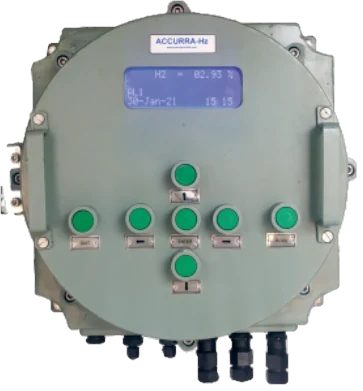
ACCURRA-Hz
Process gas analyser in an enclosure certified for Gas Group IIC, Zone 1 and 2, T6.
View ACCURRA-Hz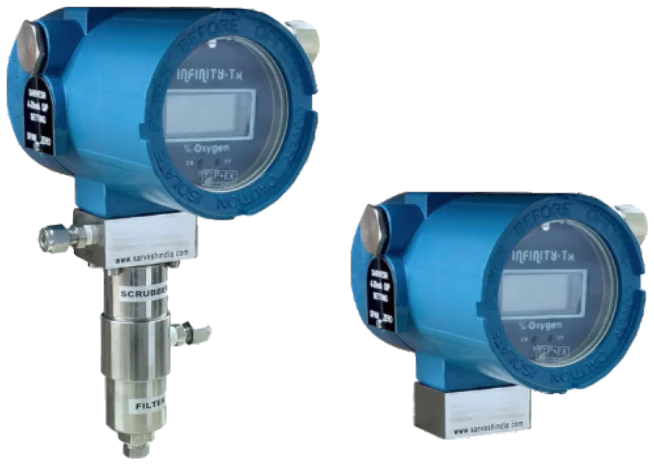
INFINITY-Tx
Loop-powered two-wire transmitter for percent O2 and trace CO in hazardous areas.
View INFINITY-Tx